     |




















 |

"A word aptly uttered or written cannot be cut away by an axe."
—Nikolai Gogol, 'Dead Souls.'
|
According to Cox, the Kickstarter process would allow him to make a better film because it "produces a film which is project-driven, or director-driven, rather than made as a 'star vehicle.' It's a rare opportunity for a filmmaker to be able to cast the film right, with the best actors available." Cox credited collaborators Guillermo de Oliveira and Zack Coffman, "who have shown me the way to properly crowdfund a feature." He adds, "the entire creative team is thrilling. Phil Tippett—legendary special effects artist, stop-motion animator, and director of MAD GOD—has offered to design and build our flashback, in which the boy Strindler is abandoned by his father in a snowstorm." A page from Cox's storyboard book he made for thr VFX scenes—the ones Tippett Studio is using to create the flashback—and the El Condor Mexican street and graveyard, as shown below:"

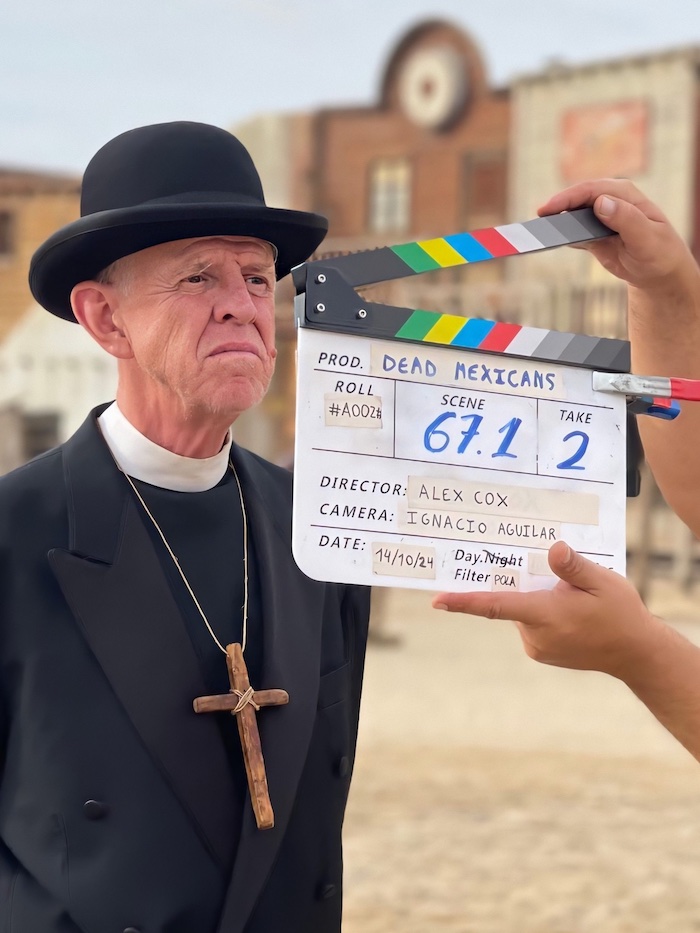
An issue that plagued Cox throughout the production was the project's title. Originally the film was to be called Dead Mexicans, an update of the source material's title, adjusted for its new setting. But some people appeared to be offended. Cox said at the time, "One actor, having been cast and costumed, quit suddenly, advising us that their 'counselors' had urged them not to be in the film due to its racism (this was on US Election Day, when Trump Derangement Syndrome was causing strange behavior across the land). Another actor—whom I know and esteem—did a great job but told Merritt that he wouldn't take a credit unless we changed the title. Someone else called the title 'an act of violence.'" Cox continued, "What is the problem here? ... The script was translated into Spanish by a Mexican writer in Oaxaca, and two Mexican producers in Mexico City immediately came on board and for several months tried to raise funds for it. No Mexicans have complained to me, or them, about the content, nor about the title."
By the time of the Arizona shoot, the title had been changed to Government Work. This is what Strindler sometimes claimed to be doing while counting those dead Mexicans. Cox said, "We did this because we didn't want to offend people who are apt to take offence. I don't think the film, or the title, are racist. Rather, the film deals with racism. It deals with other things too. But the exploitation of 'foreign' nationals (who until recently owned the American Southwest) is its background, just as the exploitation of serfs was the background of Gogol's book... I love Mexico. I have lived and worked there, and directed two Mexican features, El Patrullero and Death & the Compass, with Mexican casts and crews. Most of my acting has been done there, in Spanish, in films like La Ley de Herodes, and the series Un Estraño Enemigo. Get Out! and Blue Collar also deal with racism. But they are not racist films."
Producer Merritt Crocker wrote on Facebook, "the original title 'Dead Mexicans' was controversial. It makes sense given the production took place mainly in Arizona during last year's election. But, on the other hand, the story deals with the devaluation of human life and of course we all know you shouldn't judge a book by its cover... surprisingly, Alex ultimately chose to change the title to match the book on which it's based. End of the day, this was a fun project and he was/is a good boss. Firm in his beliefs though not unflexible. Old school, pragmatic, funny. The amount of work he put into this at 70 years is impressive."²
One thing that this controversy finally proved was how good the title was of Gogol's original book: "Dead Souls" didn't just refer to the victims in the story. It also referred to the souls of the novel's hero and the landowners he swindled: they were all as dead inside as the deceased serfs whose names were being sold. It's still a great title, and finally, it proved to be just as perfect for the film.
"Keep not money, but keep good people's company."
—Nikolai Gogol, 'Dead Souls.'
By this point, post-production was starting in earnest: On January 30, 2025, Cox wrote, "At the beginning of January, Merritt Crocker (our producer/editor, as he was on TOMBSTONE RASHOMON) came up to Oregon and we watched his first cut of the film. It was very good. Of course, I am a tad biased, but I think this is the best ever Western version of DEAD SOULS. We worked together for a few days, then he returned to California and I worked on sound effects and footsteps for a couple of weeks." Crocker and Cox then met up at Phil Tippett's house, and combined their resources to complete a cut of the film. The next day they screened the film for Tippett and his VFX crew, as well as composer Dan Wool and sound designer Richard Beggs, on the Pixar Campus in Berkeley. Cox noted, "This was something of a crucial screening. Dan had visited the set, but it was the first Richard or the Tippett crew had seen of the film. Fortunately they seemed to like it, and signed up for the remainder of the trip."
After the screening, the group repaired to the Tippett Studio Canteen, Juan's House of Cheese, where Merritt took the picture shown below. From left to right, that's Phil, Alex, Dan, and Richard (and Merritt's shadow flashing a peace sign in the foreground). "Between us we are almost 300 years old!" noted Cox. "And since we all fell in love with the cinema as toddlers, almost all those three centuries have been dedicated to the Art of Film."

"What in earlier years would have brought animation to my face, arousing laughter and incessant chatter, now slips past me and my immobile lips preserve an impassive silence. Oh my youth! Oh my freshness!"
—Nikolai Gogol, 'Dead Souls.'
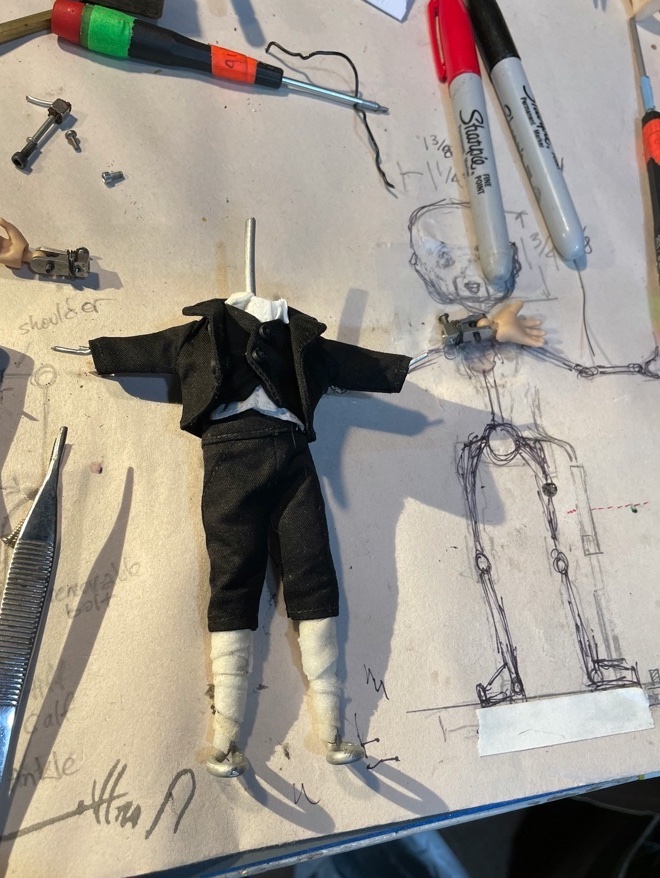
CMo at Tippett Studio completed the first VFX: the grim piles of copper tailings at Oso's mine, while Ken prepared to blow up a cantina. Meanwhile, Tom "Gibby" Gibbons was placed in charge of the most complex of all the effects: an ambitious Flashback involving a snowy mountain pass, an orphanage, a sleigh, reindeer, and the Young Strindler.
 |
 |
 |
 |
|

|

|

After post-production wrapped and the film headed for the festival circuit, Cox wrote: "Gianni Garko—the legendary Western actor with whom I collaborated on the script—has watched the finished film and sent me a very nice note about it. Here is a fragment: "I'm still moved by its terrible ending. I can tell you right now that your film deals the final blow to the legend of the Wild West, as Hollywood cinema built it. The Italian Western had demolished half of that legend and at the same time had somehow brought it back to life. You have portrayed the roots of capitalist America, truthfully, but also with profound melancholy." Cox added, "Gianni had great things to say about the cinematography, which is quite wonderful. And also some compliments for the principal actor. But I am too shy to share them."³
But still more changes were in order! Geoff Marslett's new credit sequence was inserted in late December of 2025, and Dan Wool added some elements to address the additional gunshots therein. (If you saw the film in Almería, Sao Paulo or Rio, you saw Merritt's opening titles (shown below); if you watched it in Rotterdam or San Francisco, you saw Geoff's.)

  |
  |
  |
 |
NOTES ON THIS PAGE
¹—"Kickstarter Campaign": Cox details his strategies and goals for the production.
²—Facebook post by Merritt Crocker, 10/17/25. He added, "the film plays in São Paulo this weekend. I'll be there drinking caipirinhas."
³—"Update 32: Festival Report 1, Tabernas" by Alex Cox, 10/10/2025.