     |
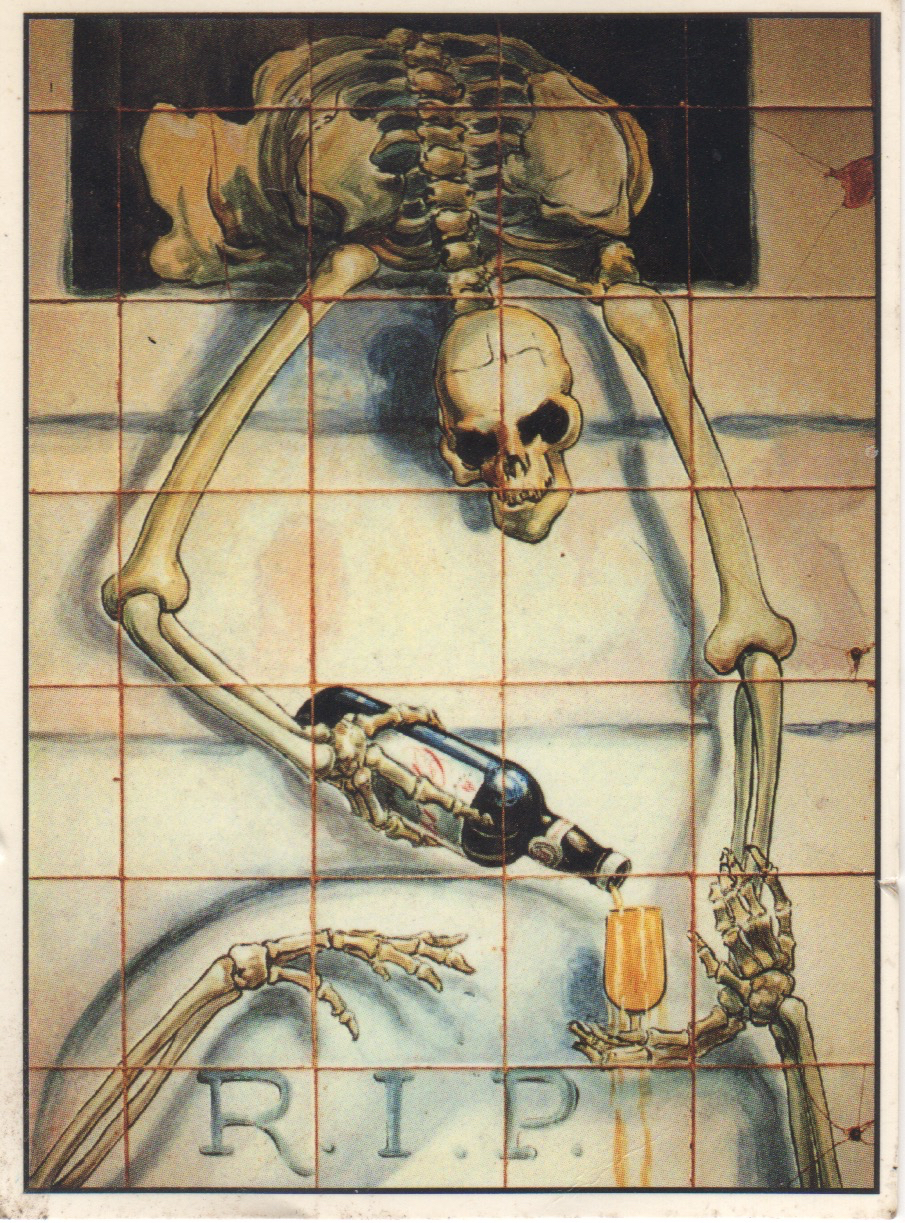





















"I know that, by my ill-considered and immature works, I have brought distress to many and that I have even provoked others to attack me openly and, in general, have produced displeasure in many."
—Nikolai Vasilievich Gogol
|

The "Repo Man" director Alex Cox returns with an unabashedly weird western, where he plays a mysterious stranger in an Arizona border town, circa 1890.
By Beatrice Loayza | New York Times | August 13, 2026
When an enigmatic man in a bowler hat arrives in a rough-and-tumble frontier town in Arizona, circa 1890, the locals question his motives. He claims to be a government worker in one account; in others, he's a preacher. His prim attire and gentle demeanor certainly makes him seem like he's on the side of some righteous authority. But then why is he searching for the names of dead Mexican laborers and willing to pay anyone who can add to his list?
If you've read Nikolai Gogol's "Dead Souls," which this weirdo western of the same name is loosely adapted from, you'll know the answer. Strindler, the mysterious visitor played by the director Alex Cox, sounds an awful lot like swindler, which is one of the countless winks and bone-dry gags scattered around this mean satire about American cycles of exploitation.
A counterculture heavyweight in the 1980s and '90s, Cox ("Repo Man," "Straight to Hell") got $214,000 for "Dead Souls" via a Kickstarter campaign. The artistic independence afforded by such a financing scheme certainly shows: Cox shot on location in Mezcal, Ariz., and Almíria, Spain (the capital of 1960s spaghetti westerns) and wrote the script with Gianni Garko, one of the genre's leading men. Strindler's journey, which consists mostly of cryptic exchanges with locals in saloons and stables, is punctuated by exciting detours (one, for instance, is a musical number involving zombies).
The film's small budget shows in the flat cinematography and stagy performances, but this effect—in which Wild West intrigue comes off as comically wooden—also vibes with Cox's metacommentary on cinema and his own place within its lineage. These details will almost certainly be lost on those unfamiliar with the director's shtick. Meet Cox halfway, however, and "Dead Souls" makes for a riotous swan song.
|

By Peter Sobczynski | RogerEbert.com | July 22, 2026
British filmmaker Alex Cox has indicated that his latest film, "Dead Souls," will be the capper of a career that started off with a bang in the mid-80s with such cult classics as "Repo Man" and "Sid & Nancy" before going off into stranger areas following the critical and commercial failure of "Walker," his brilliant, frighteningly prescient and largely misunderstood take on America's past and present misadventures in Central America over the years. If this turns out to be the truth, Cox has chosen to go out on a high note with an offbeat and proudly political riff on the spaghetti Westerns of old that serves as an inspired summation of the themes and attitudes that have driven his work throughout the years.
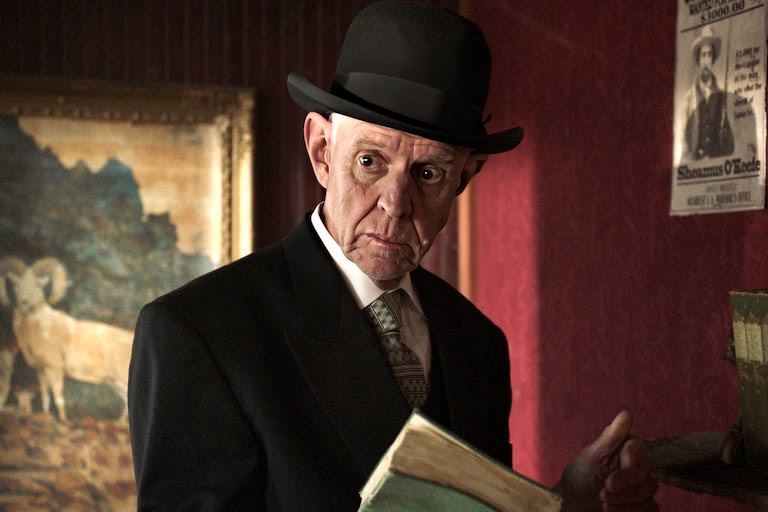
Set in 1890, Cox himself stars as Mr. Strindler, a courtly, well-dressed man who, as the story opens, arrives in a small border town in Arizona that seems to have been designed to eat those who look like him for breakfast. Nevertheless, after checking into the local hotel, he begins ingratiating himself with a number of the town bigwigs, including the mayor (Eric Schumacher), the sheriff (Brendan Guy Murphy), and the owner of the local mine (Ted Falagan), by showing that he has money to spare during a card game that he is careful not to win. Having established himself, Strindler starts going around town, ferried about by Borracho (Zander Schloss), the grizzled local who knows everything about everybody, to visit the most prominent citizens with an odd proposition—he will pay them good money for the names and birthdates of the Mexicans who have either died in their employ or on their land.
Why is he doing this? He never comes out and explains why. Indeed, with each encounter, he changes up his explanation of who he is, at various times claiming to be a census taker, a representative of both the U.S. and Mexican governments, a reverend, and even part of the funeral industry. The people he is dealing with don't seem to care much—between their day-to-day exploitation of Mexican workers and a past massacre that is only hinted at, there are a lot of names to sell, and by passing them on to Strindler, they can theoretically rid themselves of any personal guilt they may feel and make a tidy profit at the same time. As time goes on and Strindler's cash begins to dwindle, some of the townspeople begin to get a bit suspicious of both him and his motives, eventually leading to a young hothead known as The Kid (Shayn Herndon) challenging him to a duel in the streets. While I won't tell you how that turns out, I can say that this is the point where the film takes a decided turn for the weird. How weird? Put it this way—it finds room for both a musical number in which a number of characters (living and dead) suddenly burst into a rendition of "Streets of Laredo" and a stop-motion animation sequence, and neither of those quite qualifies as its most audacious leap.
Oddly enough, the basis of "Dead Souls" is a 1842 book by Nikolai Gogol that has been reconfigured in the mode of all those spaghetti westerns that were cranked out back in the 60s and 70s for which Cox has a well-known affinity—not only did he shoot a good portion of the film in Almeria, Spain, where many of those films were made, but he also collaborated on the screenplay with Gianni Garbo, an Italian actor who appeared in a good number of them as well. Admittedly, no one is going to mistake this film for any of the epics directed by Sergio Leone—most of the film consists of a couple of people talking to each other, and there are only a couple of moments involving violent gunplay, played more for laughs than thrills. However, despite working on a small budget, he manages to conjure up the kind of sweaty, scuzzy atmosphere that helped make those original films subvert the cliches of old-fashioned Hollywood westerns. If it lacks the operatic excesses of this particular subgenre, it does an interesting job of recasting those elements into something closer to an intimate chamber piece.
Although this might make the film sound like a sort of companion piece to "Straight to Hell," his delightfully bizarre 1987 contemporary take on the genre, it bears closest comparison to the aforementioned "Walker." Like that film, this one uses a story set in the past as a way of commenting on current issues, tackling everything from immigration (with Strindler at times coming across like an ICE agent, albeit one only interested in targets who are already dead) to the way in which practically anything—even one's death—can be reduced to just another commodity to the ways in which history can be manipulated by those in power. Also like that film, it isn't exactly subtle in how it goes about it. The results are quite funny at times, but this is not meant to be a spoof by any means; beneath the offbeat nature of the film in general and Cox's performance in particular (whose enigmatic turn comes across like a hybrid of William S. Burroughs and Stan Laurel) is a real sense of anger about how things are today that is both striking and hard to shake.
Clearly, "Dead Souls" is not a film for everyone—it is unlikely to bring any of the moviegoers who bailed on Cox for refusing to simply rehash "Repo Man" over and over back into the fold. That said, there must still be a few daring souls out there looking for something different—and a film that takes a 19th-century excoriation of Russian bureaucracy and transforms it into a caustic take on contemporary issues filtered through the lens of an old Sergio Corbucci programmer certainly qualifies as "different." If this does prove to be Cox's final directorial effort, it is nice to see him going out literally guns a-blazing.
|

By Armond White | National Review | July 22, 2026
While commentators debate the fidelity of Christopher Nolan's adaptation of Homer's 3,000-year-old epic The Odyssey, Alex Cox—the director of Repo Man and Sid and Nancy—braves a wily adaptation of Nikolai Gogol's Dead Souls, from 1842.
It is Cox's latest act of punk-rock effrontery, reworking Russian literary satire into his favorite genre—a farcical pop-cinema spaghetti Western. Cox himself portrays Strindler, a mysterious solitary Brit who treks through 1890s southwest Arizona territory, collecting the names of deceased Mexican-immigrant workers to cash in on their bosses' tax liabilities.
Cox's stunt (modeled after the scheme of Gogol's protagonist Pavel Ivanovich Chichikov) not only flaunts literary tradition, it spoofs historical movies to reflect the current immigration/invasion crisis.
Whatever Nolan thought his work The Odyssey accomplished, Cox's modern adaptation is consistent with his culturally savvy social commentary. Mixing genre parody, deadpan humor, and songs, Cox's anarchic jamboree follows his 1987 Western burlesque Straight to Hell, which featured Joe Strummer, Courtney Love, Dennis Hopper, Grace Jones, and Elvis Costello, as well as Searchers 2.0, his 2007 faux John Ford homage.
Strindler is first seen walking through the strange, vast desert, like the forlorn Harry Dean Stanton in Paris, Texas, suggesting an anachronistic mythological figure whose appearance sparks the settlers to reveal themselves as dissatisfied, competitive types. These billiard players and card-shark gamblers invite Strindler to take part in sharing their disparate American dreams, plus their portion of Western heritage—including Diogenes searching for one honest man, a piano rendition of "Night on Bald Mountain," and praise of "Melville's great book about The Whale." Strindler counters with his preference for a tome about the 19th-century American insurgent William Walker (subject of Cox's 1987 satirical polemic Walker, starring Ed Harris).
The insurgency of Dead Souls lies in Cox's response to American history. Western aggression also inspires Cox's own outsider's awe—and it's musical. When The Kid (Shayn Herndon) challenges the unarmed Strindler to a shootout, the tragic duel shifts the film into the year's most wondrous sequence of spiritual nostalgia: Several town folk trade personalized verses of the ballad "The Streets of Laredo/The Dying Cowboy." It's wistful enough to stir a corpse.
What's going on in Dead Souls is an old anarchist's nostalgic fantasia, blending Western themes in the wake of contemporary politics that he can't quite rationalize. Cox stretches Gogol's dead-souls metaphor to include the world's unidentified immigrants as well as the bureaucrats and politicians who exploit them.
Strindler befriends coachman Borracho (Zander Schloss, the first man disintegrated in Repo Man), who confesses his own old rebel's dream: "There were these big mansions, rising way up high. Yet everywhere you looked, there were poor people sleeping on the streets, living in tents. It was like that all over the world." Strindler surmises, "You experienced what the French call a cauchemar—a fever dream." The film itself evokes what Vladimir Nabokov most admired about Dead Souls: "Gogolian gusto and wealth of weird detail." (Nabokov insisted that Dead Souls was great art, not a political manifesto.)
A poignant animated sequence helps Cox achieve a narrative coherence that Rade Jude could not in Dracula, his own blended fantasia of East European political heritage. After that summation, Strindler is told "You're a man of the future!" and he imagines military bureaucrats in a contemporary setting who tally the dead—an 1844 list of deceased serfs in Kiev; an 1890s record of buried Mexicans in Arizona; 20th-century Nicaraguan fatalities; and finally "Schindler's list."
Cox's rude movie joke exposes the enigmatic Strindler, paralleling how Godard critiqued Spielberg's recreation of Auschwitz—the maddening moral weight of political history. And now, political ethics have changed treacherously (from globalism to neo-socialism), proving that the Punk era's innocent charm—as vulgar as the pre-Marxist era that Gogol described—is dead. "It's an AI-centric project," Strindler is enlightened. Smarter than Nolan, punk artist Cox disrupts the megalomania that comes with a Hollywood super-production. Inspired by Gogol, Cox says this will be his last film.
|

By Betsy Sherman | Boston's Premier Online Magazine | July 28, 2026
Dead Souls—Directed by Alex Cox. Playing at The Brattle Theatre, Cambridge, on July 31 at 9 p.m., August 1 at 2 & 9 p.m., August 2 at 8:30 p.m. and August 3 at 10 p.m. The Brattle will also show Alex Cox's 1987 spaghetti Western spoof Straight to Hell (with Joe Strummer, Courtney Love, and Sy Richardson) on August 1 at noon.
I first heard of Nikolai Gogol's novel Dead Souls in a 1975 Playboy interview with Mel Brooks. My idol Mel said it was a masterpiece, so I read it and happily went on to Gogol's absurdist short stories, including The Nose and The Overcoat. The 19th-century Russian satirist is a favorite of Brooks' ("Comedy and humanity, and he knew what he was talking about"), and an influence. Does this mean that Blazing Saddles is a little bit of an antecedent for British director Alex Cox's setting his loose adaptation of Dead Souls in America's Old West? As a comedy, Cox's movie is more chuckle-funny than Blazing Saddles' lose-your-shit-funny. But like the Brooks movie, it lampoons greed on the old frontier and indicts the deadly callousness of white settler society toward people who don't look or speak like them.
In that respect, it will please fans of the director-writer, who began his career with the punk splendor of Repo Man and Sid & Nancy. Cox, now 71 years old, made the lovely late-career gesture of casting himself as the protagonist, a version of Gogol's weaselly Chichikov. He's delightful in the role. But the production as a whole may be too disjointed to win over viewers who like their movies more, well, jointed.
This crowd-funded project—publicized as Cox's last film as director—transplants Gogol's 1842 story into the world of the spaghetti Westerns the director loves so well (he wrote a book about the genre, 10,000 Ways to Die)). In the Russian tale, a former bureaucrat bargains with landowners to sell him the names of their deceased serfs who are still on the census rolls as alive. Why, no one knows, not even readers, until a late chapter. The novel contains a panoply of vividly drawn supporting characters, as Gogol skewers bureaucracy, noxious trends from France, and Russia's waste of talent and natural resources.
The film takes place in 1890 in the American Southwest. A man in a black suit and bowler hat strides across the arid landscape, examining a cemetery before he enters a border town with Western-movie trimmings. Named Strindler, he's inquisitive and affable as he makes the acquaintance of the "big cheeses": the mayor, the sheriff, the mine owner, and the major rancher in the area (along with his adult daughter). A buzz goes around about the stranger's odd request: he asks people about "their" Mexican laborers, and offers cash for the names, ages, and birthplaces of the dead ones. His spiel varies by target. To one he claims to work for the U.S. government, another the Mexican government, another a funeral business, and to others he poses as a clergyman.
The harmless-looking Strindler finds himself challenged to a shootout, to take place in the morning. To avoid death, the stranger takes advantage of tensions over the law-enforcement killing of one of "the Zamora brothers" and that Mexican family's wish for revenge. There are funny bits, such as the town doctor's kids being hooked on a "temperance" beverage containing coca leaves and cola nuts. The standout supporting turn comes from Zander Schloss (one of many Cox regulars) as the town drunk who chauffeurs Strindler in a wagon. He's an Anglo fittingly nicknamed Borracho (Spanish for drunkard).
Much of Dead Souls was shot in Almeria, Spain, the location for many European Westerns. The later scenes were shot by a different crew in Mescal, Arizona. Saguaros enhance the beauty of this landscape. Cox co-wrote the screenplay with legendary Italian spaghetti-Western actor Gianni Garko. Most characters are counterparts to characters in the novel, but in a Yosemite Sam cartoonish way (there are prize fake mustaches and muttonchops, and the sheriff has metal teeth). The original score by Dan Wool has the spaghetti feel, and song choices include a parody of "The Yellow Rose of Texas" and a "Streets of Laredo" number led by bombshell Sarah Vista, who plays a widow convinced that Strindler has cheated her. Movie references abound, and do I detect the articulation of John Huston in Cox's adopted American accent?
In the wake of politically conscious Cox films like Walker (1987)—in which the mercenary activities of William Walker (name-checked in Dead Souls) in Central America pointed towards those of the Reagan administration—the director connects his story, real American history and current headlines. For example, the repetition of the phrase "dead Mexicans" and the practice of deporting live ones back to Mexico conjure up the dehumanizing policies of Trump and Stephen Miller. The character of John H. Behan, with whom the "Reverend" Strindler meets in El Paso, Texas, is a real-life figure who also appeared in Cox's Tombstone Rashomon (2015), both times played by Jesse Lee Pacheco. In the previous movie he was a sheriff; in Dead Souls, as was true, he works as a Chinese Exclusion Inspector, hunting down and removing Chinese workers. Swerving into the conspiracy-theory lane, there's a surprising sequence that I wouldn't dream of spoiling.
The picture ends with an assertion of identity. Alex Cox is back, and this is a good time for adventurous moviegoers to pay homage to the punk elder who has survived to where he can name in advance his own swan song.
|
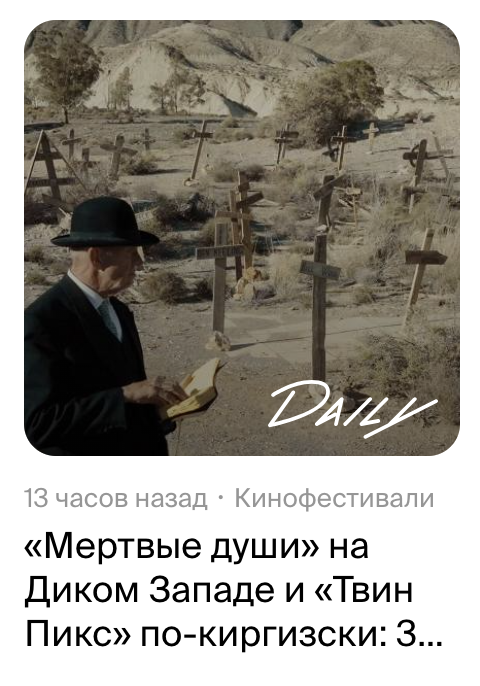
By Evgeny Tkachev| Afisha Daily | June 30, 2026
The 20th "Zerkalo: Tarkovsky's Philosophy" International Festival of Cinema, Music, and Architecture has concluded in Ivanovo. The event showcased fresh films from leading European festivals—ranging from the Berlinale to the Rotterdam International Film Festival—as well as premieres of new Russian movies. Evgeny Tkachev discusses the three films that impressed him the most.
*Dead Souls* (dir. Alex Cox)
Main International Competition. Audience Choice Award, © "Zerkalo—2026"
It is a rare stroke of luck to see a new film by cult British director Alex Cox, and an even greater one to watch it on the big screen. While the name of this punk-rock filmmaker may have faded somewhat from memory today, back in the 1980s he rose to fame with the acid-fueled sci-fi flick *Repo Man* (not to be confused with the 2010 film of the same name) and the biopic *Sid and Nancy*, starring Gary Oldman and Chloe Webb. However, his very next project—the Western *Walker*, characterized by long takes—proved to be a failure, and he famously stepped down as director of *Fear and Loathing in Las Vegas* due to creative differences.
After gradually parting ways with major studios, he began making indie films, frequently gravitating toward the Western genre. Examples of such films include *Straight to Hell*—featuring another counterculture icon, Jim Jarmusch—and *Searchers 2.0*, a meta-commentary on *The Searchers*. *Dead Souls*, which marked a genuine comeback for Cox (his previous feature film had been released nearly a decade earlier), also adopts the Western genre; the director transposed the action of Nikolai Gogol's poem from the Russia of the serfdom era to the Wild West. It was clearly shot on a shoestring budget—"a fistful of dollars," so to speak—since, much like his earlier films *Bill, the Galactic Hero* (based on Harry Harrison's work) and *Tombstone-Rashomon*, the funding for *Dead Souls* was raised via crowdfunding.
What remains when studio resources vanish? Pure directorial style. And *Dead Souls* has that in abundance. Cox, who cast himself in the lead role (presumably to avoid spending his already meager budget on another actor), appears as the shifty Strindler. He roams the frontier—occasionally posing as a pastor—buying up the "dead souls" of Mexicans in a bid to get rich, proving that every penny counts.
The work's Russian roots occasionally break through: in the song "Dark Eyes" (*Ochi Chernye*) playing over the opening credits, in the name of the orphanage—"Sirotstvo" (Orphanhood)—which left some viewers puzzled as to why it was in Russian, and in verbatim quotes from Gogol. Yet, for the most part, Cox's film is an original work. It is not merely a loose adaptation, but an Anglo-American fantasy inspired by *Dead Souls*. As is often the case with this director, there is plenty of irony here—sometimes veering into outright buffoonery—but the humor is primarily gallows-style: macabre, mocking, and fiercely satirical. Since "Strindler" is essentially a reverse—Schindler, a joke about "Strindler's List" inevitably follows. All in all, Cox has found an ideal collaborator in Gogol—a writer who also blended the terrifying and the comical with zest—while finding echoes of Gogol's Rus' in the American frontier.
Audiences unfamiliar with Cox's work might initially find *Dead Souls* utterly bizarre, but the film deserves a chance. The director takes his time harnessing his "troika" (the Russian three-horse sleigh), but as the finale approaches, he spurs it on and goes all out: an animated flashback, a shocking flash-forward, a suspenseful climax, and "fear and loathing" in the Wild West. *Repo Man* transforms into *R.I.P. Man*, and the film expands into a biting statement on the three universal problems: fools, roads, and enterprising "Chichikovs" who profit from dead souls.

FILM THREAT: Dead Souls (9/10)
By Bobby LePire | Film Threat | February 9, 2026
|

Strindler has Borracho (Zander Schloss) ferrying him about to talk to the Mayor Avery (Eric Schumacher), Sheriff Purdy (Brendan Guy Murphy), and the head of the mine, Oso (Ted Falagan). With each new encounter, Strindler claims slightly different reasons for wanting a list of names of dead Mexicans. But the secrecy surrounding what the man is doing gnaws at The Kid (Shayn Herndon), who challenges the elderly Strindler to a duel. Will Strindler survive the gunfight, or will the mystery of his deeds be his undoing?
Dead Souls is funny in that offbeat, purely Cox kind of way. For anyone familiar with the man's output, the kind of humor at play will feel comfortable. But does the comedy work with the mystery and drama of it all? Very much so, yes. Strindler saddling a horse the wrong way might sound like an expected joke, but the punchline isn't that he's backwards on the beast. Just about every moment of levity is working two or three punchlines at the same time. This means that, despite the narrative's heaviness, it is constantly amusing.
Luckily, the strangeness of Strindler's business, as well as the man himself, is intriguing. The need for the list is unknown to all; there is no dramatic irony here. The reason Strindler reinvents himself for his audience adds to the mystery that is afoot. By the time the musical number hits, audiences are either all in or have already tuned in. If viewers stick around to the end, they will be treated to an unusual, fun western that is peculiar to a fault.
The theme of Dead Souls isn't exactly subtle. This is a story about the status and rights of immigrants and the jobs they hold. That it is told via the deceased adds a layer of belief and the roles of life and death play in how one remembers someone's legacy. It shouldn't be much of a surprise to find out where the outsider artist Cox lands on these issues. The enjoyment comes from experiencing the wild, original way he and his co-writer chose to put those ideas and values on the screen.
Cox plays Strindler with a mix of confusion and determination. He cuts a decent protagonist, and knows how far to push the character's comedy and the mystery to not throw off all watching. Schloss is tons of fun as the lead's forced accomplice. Falagan's speech, but who is actually honest, really makes audiences think. Herndon comes across as so unhinged that he's scary. Amariah Dionne plays Rose, and she brings a lot of heart and sweetness to the part.
Dead Souls is mannered, very mannered, which might throw some audience members off. But the comedy, drama, and mystery all work well. The message is keenly observed and told with a sharp wit. The cast is strong, with Cox being a very charismatic and enigmatic figure. If one likes Cox's other films, then this will be a no-brainer to check out. If an audience member loves westerns, then this is an easy recommendation. However, viewers who don't want to think will do best to look elsewhere.
FILMUFORIA: Dead Souls Rotterdam Film Festival (****)
Reviewed by Peter Herbert | February, 2026
|

Nikolai Gogol's 'Dead Souls' has been described as "an epic poem of hallucinatory reality pushed into the surreal". Admired and influential in literary circles, the writing has been filmed as Russian film and tv versions. Alex Cox is the first western filmmaker to adapt the 1842 poem and for this reason is more than welcome as Dead Souls also finds the British director delivering one of his most accomplished films.
The opening credit titles reference Luis Bunuel's The Exterminating Angel as a mysterious stranger walks out of a barren western landscape into a small frontier town. He is Strindler, a government inspector tasked with offering prominent townsfolk an unusual and somewhat macabre proposition. Arranging to buy rights to dead Mexicans registered as burials for possible lucrative reasons, his strange behaviour arouses suspicion as he ingratiates himself into the community.
The narrative simplicity of the first half builds around Cox's central performance as Strindler who shuffles encounters with others as if playing a pack of cards. The performance is not unlike the way Ed Harris's firebrand revolutionary holds together Walker for Cox in his 1987 film.
The charisma of Cox with his striking visual persona is balanced by a mix of finely played characters. Actors Merritt Crocker, Shayn Herndon, Eric Schumacher and Ed Tudor Pole also display extravagantly moustached facial hair while Karen E Wright, Maria Robles and Amariah Dionne provide striking female cameos. The widow is hauntingly played by British singer songwriter actress Sarah Vista who is a smouldering vision of the devil as a woman negotiating with Strindler behind her veil.
The film also contains the widow in a musical dream version of The Streets of Laredo that includes a deeply moving male voice acting as a form of surreal chorus for the song's traditional lament of death. The sequence precipitates the second act where the tone of the film splinters further as snuff smelling Strindler descends into tragicomic absurdity while he pays the price for gambling with Gods of death.
Cox handles shifts of tone in the second half with his familiar puckish punk sensibilities. These include how he mounts a horse or suffers the vile effects of drinking from a 17-year-old bottle of liquid. There is reference to the philosophical quote a man who fears death is not alive and hallucinatory animation reveals how he was abandoned by his father who raised him to trust money more than friendship.
The beautiful camerawork of Ignacio Aguilar and Chance Faulkner is reminiscent of great traditions of westerns made in Arizona and the Spanish region of Almería. The soundtrack reflects Cox's love of music and is a curated collection of spoken word, including a wild rendition of Mussorgsky's Night on Bare Mountain and traditional early western ballads. The script contains themes involving immigration and displacement allowing Dead Souls to offer moral and allegorical comments on the current state of world and American politics.
It is possible to speculate on one of the film's literary quotes. This is a reference to Herman Melville's novel The Whale aka Moby Dick which was made into a film by John Huston. It is not inconceivable to imagine that Huston, as with Cox in a dual acting/filmmaking role, is another rogue filmmaker who could bring to life the quixotic antihero at the centre of Gogol's poem. Dead Souls concludes on a vivid closeup of its creator and is rumoured to be Alex Cox's last movie. If this is the case, Dead Souls offers the perfect sound associated with a swan song and stands high amongst the best finales of any filmmaker's career.
Alex Cox's Dead Souls
By Jim Ruland Feb 18, 2026, Message from the Underworld (Substack)
The next morning I drove up to San Francisco and met Nuvia at our hotel near the airport. We had just enough time to change clothes and drive to the BART station to take a train into the Mission where Alex Cox's new movie Dead Souls was screening at the Roxie.
His latest project is an adaptation of Nikolai Gogol's novel of the same name, a western set in the Arizona territory in the 19th century, and a biting commentary on the commodification of human beings under the Trump administration. Cox puts in a stellar performance as the mysterious stranger who comes to town, and it gets weirder and more violent as the story unfolds.
Leave it Cox to go all the way to Almería, Spain to shoot a low-budget movie set in Arizona. Dozens and dozens of films have been shot in Almería, including Lawrence of Arabia, A Fistful of Dollars, and too many spaghetti westerns to count. It's also where Cox shot Straight to Hell with Joe Strummer, Sy Richardson, Dick Rude, Zander Schloss, and Del Zamora. The latter three actors also appeared in Repo Man, Cox's first feature film, and Dead Souls, which he is calling his last.
After the screening, Cox graciously shared the spotlight with members of the cast and crew, many of whom are just beginning their film careers. Schloss, who also happens to be the bass player the Circle Jerks, disappears in his role as Boracho. He plays a teamster who ferries Cox's character around the empty yet eerily familiar desert in a horse-drawn wagon. During the Q&A, Schloss commented how poignant it was to be clomping around the Spanish desert with Cox after all these years.
There was a feeling in the Roxie of a reunion, of things having come full circle, which felt appropriate on the cusp of the Chinese New Year. Cox hinted that a deal with an American distributor was imminent so keep your fingers crossed that Dead Souls will be coming to screens big and small soon.
 |
 |
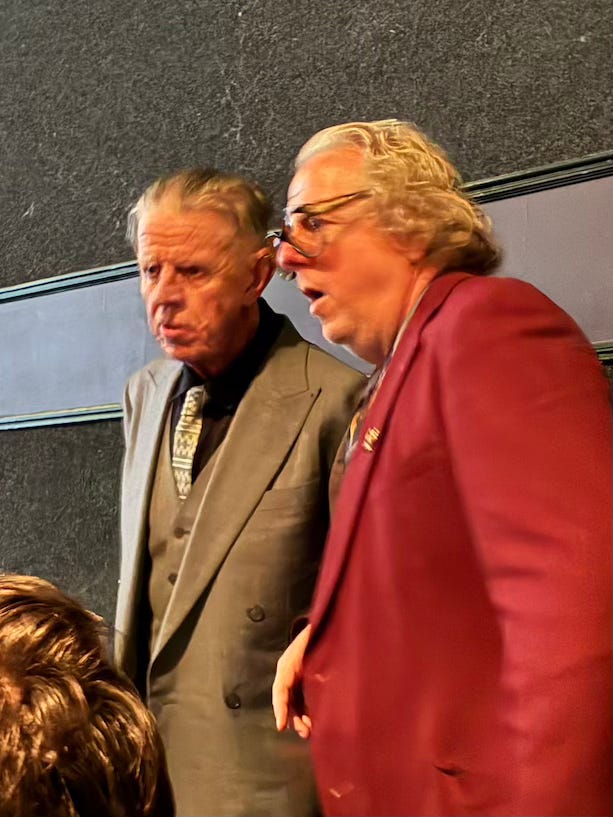 |
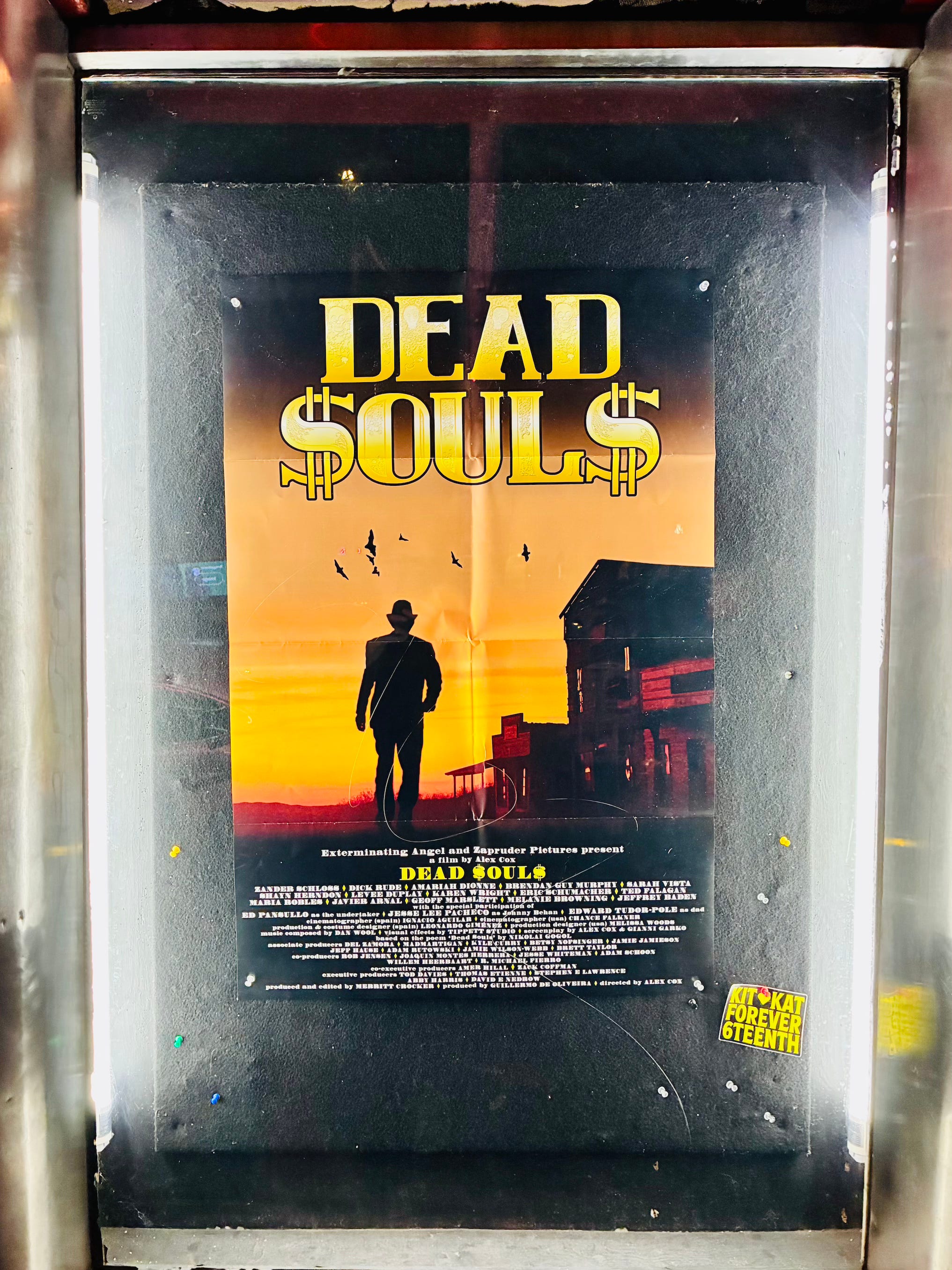
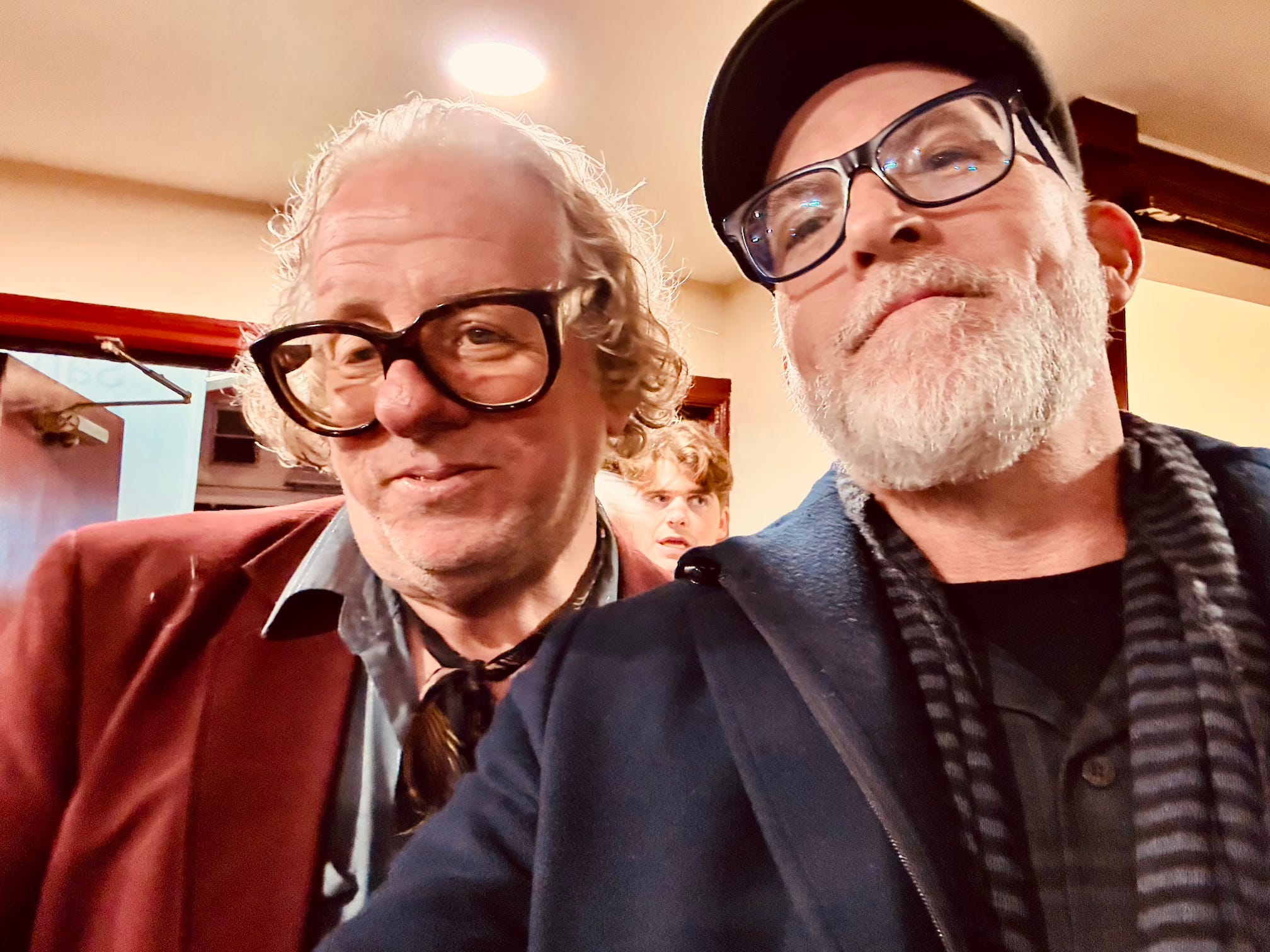
Dead Souls poster, Zander & Jim, Alex & Zander.
Dead Souls on the U.S. Border: On Alex Cox's "Final Film"
"Alex Cox, in what may be his final film, smartly reconfigures the classic theme of bureaucratic greed in Tsarist Russia into a bold, timely political Western situated in the borderlands of the 19th-century American West."
By Jenny Paola Ortega Castillo. Film International (Filmint.nu) This remarkable film, which was the closing night feature at SF IndieFest, from one of the amazing indie genre representatives with such great works as Repo Man and Sid & Nancy, has made visible the decades spent orbiting the Western culture in both his roles as an historian and a filmmaker. His book 10,000 Ways to Die is a perfect admiring reflection on the classic spaghetti Western excess we all know and love.
Taking up from his playful post-Western, Searchers 2.0 (2007), Dead Souls serves as the most reverent salute to the form with its breathtaking widescreen views of the marvelous landscapes of Arizona and Almería, retro-styles animated credits, and evocative score that nudges to Ennio Morricone and Sergio Corbucci, famous for reshaping the sound of spaghetti Westerns each in their own way. It is evident how his collaboration with well-known Italian Western actor Gianni Garko served the film in all the right ways. However, although this work of art offers a great homage to tradition and shows a thorough comprehension of the genre, as the film advances, it gradually starts to deconstruct the logic of the genre from within. In his lead role as Strindler, a clever reimagining of Pavel Chichikov in Gogol's classic, Cox takes on what made the original character unforgettable, an undeniable charm of a cadaverous drifter with a special ability to reinvent and represent himself. We can't quite place him or define him, but that is precisely the game, not knowing if he plays more as a government official or an itinerant preacher, all with the same, unsettling objective: harvesting lists of dead Mexican laborers in exchange for impressive sums of money from landowners. His very shady plan involves, through evident racism and exploitation, to supply the government with evidence of Mexican laborers being kept out of the territory, merely the premise in this probing and reflexive entry. Cox's anti-Right-wing statement works as an ideal closing to his career, a final step in a vibrant, career-long engagement with the Western. 'Dead Souls' review—West & Wild Observations: The Cox and the Dead. (3.5/5) By Bill Arceneaux | Moviegoing Rocks | 07 Feb 2026
Alex Cox's newest release Dead Souls (2025), stands as a brilliant adaptation of Nikolai Gogol's 1842 absurdist Russian classic, "Мертвыя души." Cox smartly reconfigures the classic theme of bureaucratic greed in Tsarist Russia into a bold, timely political Western situated in the borderlands of the 19th-century American West. It turns from Gogol's sinister fable to a well-placed and thoughtful satire about the effects of immigration, racism, and the long-lived struggle of state power and domination.

"A final step in a vibrant, career-long engagement with the Western..."
The grand and proto-independent filmmaker Alex Cox, whose movies often combine anachronisms with confusion and contradiction, has humbly presented what he states as his "last movie," Dead Souls. To what degree this is his last, I'm uncertain. A wink-wink of a tagline? An honest finale to a cooky career? Settled out in begotten parts of wild west-era Arizona, Cox is seated in both the director's chair and the body of the lead role, and, I feel, exists in the third role of a spectating spectre. A final outing for a wild spirit?
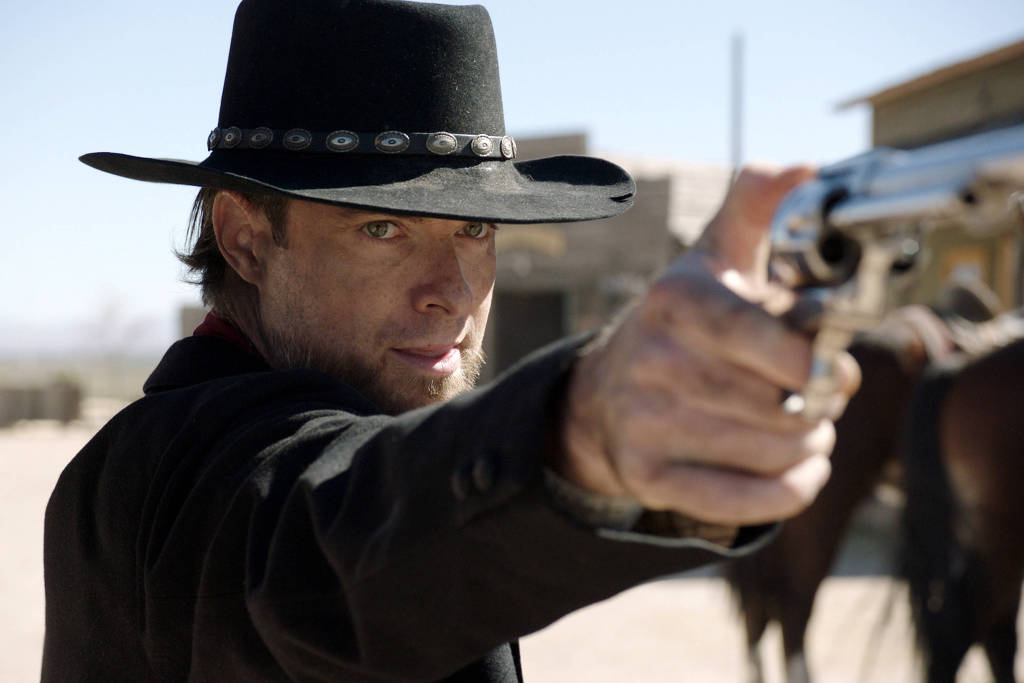
A mysterious collector of the dead names of Mexican laborers, Cox plays the newly arrived stranger in town, Strindler, who pays for his immigrant corpse listings with gold coins. Strindler masquerades with differing origins, from businessman to government agent to reverend, covering his tracks and trails in pursuit of these specific names. For someone seeking accuracy, he assumes ambiguity.
Crisp and clean cinematography overrides the dust and dirt of the West in a manner that alludes to both his present capabilities and past romances with genre-bending filmmaking. As the movie unfolds, a potentially biographical portrait of the director himself forms, or at least a memoir to which he has included cherry-picked selections from his life. All at once, Alex Cox's Strindler is written and performed not unlike a soulful vision of one's own existence, leaning through a nexus of time and place, trolling all the way to further escapades beyond this plane of living.
That's a mouthful.
Much in the mold of a mid-chapter William Burroughs book break, Dead Souls makes sense through nonsensical vagueness. It's a mystery through and through, but one that is made of answers and clarity. Each encounter rings of a past movie catalogue of familiar faces and themes, with contemporary meaning. There's not much difference in attitude or action between the late 1800s and the mid 2020s, as everything has been and likely will always be commodified and for sale.
Dead Souls is a dream of now. Sometimes too odd, sometimes too open to interpretation, but never without a cloudiness, slowly moving over pastures and people. A transfixing watch, timed to the tune of a pop-out bird clock.
Could this be Cox's final film? It's a sleight of mischief if so, perfectly articulated in ambiguity and the unnatural order of things. Such is to be expected from a playful patron of the pictures.
Alex Cox's 'Dead Souls': A Wild Ride Through the American Wasteland
nishadil.com, 2/2/2026
You know, there are directors whose very name conjures a specific kind of cinematic mischief, and Alex Cox is absolutely one of them. For decades, he's been that wonderfully uncompromised voice, always ready to poke the establishment with a sharp, satirical stick. So, when word got out about his latest, "Dead Souls," billed as a "Gogol Western," well, my ears certainly perked up. And let me tell you, it delivers on the bizarre, brilliant promise of that title and then some.
It's an idea that's frankly quite breathtaking in its audacity: taking Nikolai Gogol's masterful, scathing 19th-century satire of Russian corruption, Dead Souls, and transplanting its darkly comic heart right into the sun-baked, dusty plains of a very modern American West. We follow Chichikov, our intrepid, if morally bankrupt, protagonist—brilliantly embodied, I might add—as he meanders through a landscape utterly devoid of moral compass. His mission, as in the novel, is to acquire the "dead souls"—names of deceased serfs still registered as living, thus possessing a bizarre, albeit fleeting, value. But here, the serfs are, perhaps, the casualties of a different kind of economic and political blight.
But make no mistake, this isn't merely an academic exercise in literary adaptation. Oh no. Cox, ever the provocateur, has infused Dead Souls with a searing, unmistakable contemporary urgency. The 'dead souls' Chichikov collects become a stark metaphor, a damning indictment, if you will, of a nation seemingly willing to trade its very principles for transient gain. It's hard, honestly, to watch the sheer avarice and moral decay depicted on screen and not draw immediate, rather uncomfortable parallels to the recent political upheavals we've witnessed—particularly the unsettling, divisive era of the Trump presidency. It feels like a direct, furious response, filtered through a darkly comic lens.
Visually, it's just so Cox. You get that signature blend of gritty realism and almost surreal, dreamlike sequences, all bathed in a palette that shifts from sun-drenched desolation to shadowy, claustrophobic interiors. The dialogue, too, has that wonderfully clipped, slightly off-kilter rhythm we've come to love from him. It's a true genre mashup—not just Western and satire, but with hints of existential road movie, even a touch of B-movie grindhouse charm, all held together by a surprisingly coherent, albeit wonderfully weird, vision.
The ensemble cast, a mix of Cox regulars and fresh faces, absolutely leans into the material's eccentricities, giving performances that are both understated and brilliantly theatrical. You find yourself both repulsed and morbidly fascinated by these characters, each a microcosm of the larger societal rot Cox is so keenly observing. Is it perfect? Probably not; Cox's films rarely are in a conventional sense. Sometimes, the sheer weight of its ambition threatens to buckle under, or a scene might linger a touch too long. But these are minor quibbles, honestly. The sheer courage of its vision, the unapologetic clarity of its message, and its utterly unique voice make it a film that simply demands your attention.
Ultimately, "Dead Souls" is vintage Alex Cox: confrontational, intelligent, often hilarious, and always, always on its own terms. It's a vital, urgent piece of political cinema, a mirror held up to a nation wrestling with its own soul (or lack thereof). If you're yearning for a film that doesn't just entertain but truly makes you think, perhaps even squirm a little, then saddle up. This one's a must-see.
Dead Souls review—Alex Cox rides into sunset with anti-Trump spaghetti western
Rotterdam film festival: The Repo Man director relocates Gogol's surreal novella to the old west in what he says will be his final film
by Peter Bradshaw, The Guardian, 02/01/2026
|

The story has obvious relevance to contemporary America, and a flash-forward makes some of this clear. But it is also inspired by the classic novella of the same name by Nikolai Gogol, a mysterious parable of greed and vanity about a man who travels around offering to buy the souls of dead serfs on various estates in pre-revolutionary Russia so landowners can lower their tax bills, but plans to claim that they are still alive and therefore pass himself off as a wealthy man.
Cox transplants some of this tale to the American old west of the late 19th century. He plays Strindler, a spindly and cadaverous fellow with elaborate courtly manners, a fastidious suit and bowler hat. Strindler sometimes claims to be a government official and sometimes an itinerant preacher. Having checked in at a fly-blown hotel, he exerts himself to make the acquaintance of the local notables, including the sheriff and mayor, to whom he sycophantically loses at cards.
Strindler has a proposition to make: he will pay bafflingly large amounts of money for lists of dead Mexicans who have died on their land or in their employ. This exploitative and racist world being what it is, there are an awful lot of Mexican names to be "farmed" in this way, and it is Strindler's sinister plan to sell them on to government departments who want evidence that undesirable aliens are being excluded from American territory. But in another, stranger sense, Strindler is offering a kind of cleansing or redemption: he will take these dead people off their hands.
Strindler is a kind of proto-ICE drifter, although with a distinctive, quaint kind of innocence, and for all that he is a crook through and through, Cox shows that Strindler is outranked in crookedness by pretty much everyone he meets. He is out of his depth, and never more so when challenged to a gunfight: a duel that ends in bloody chaos, after which the recording authorities take the view that one should print the legend and not the truth.
Dead Souls has a distinctive indie-budget look, of which Cox makes a virtue by presenting the action almost as a theatrical chamber piece. Bizarre and fruity characters pop up on the parched landscape. Dead men will raise themselves and start singing. Sometimes Strindler will dream he has been catapulted into an American future during a third world war in which his services are needed to buy the names of dead Russians, Chinese and Peruvians.
It is a diverting and watchable love letter to the spaghetti west of the movies, and a satirical thorn in the flesh of Trumpian politics.
|

Stephen Dalton
January 29th, 2026
The first feature in almost a decade from maverick British writer-director Alex Cox, Dead Souls is a loose adaptation of the classic absurdist novel of the same name by Ukrainian author Nikolai Gogol, relocating the story's 19th century Russian hinterland to the lawless desert vistas of the Wild West. Originally published in unfinished form in 1842, Gogol's bitingly dark comic fable has since inspired multiple stage, screen, opera and radio versions. Cox retains the story's macabre humour and surreal undertow, but his satirical six-shooters are mostly aimed at the ingrained racism that underpins American society, both past and present, an evergreen theme which feels particularly timely in the current political climate. Making its Dutch festival debut in Rotterdam, this is an uneven but enjoyably quirky labour of love from an admirably uncompromising indie auteur.
Though best known for the pulpy sci-fi cult classic Repo Man (1984) and the junkie-punk biopic Sid & Nancy (1986), Cox has spent most of his latter career in the indie margins making low-budget variations on the western genre, riffing on stylistic tropes laid down by Sergio Leone, Sam Peckinpah, Sergio Corbucci and others. One of his later "microfeatures" was the archly titled Searchers 2.0 (2007), in homage to John Ford's The Searchers (1956). In 2009 he published a book on spaghetti westerns, 10,000 Ways to Die. On Dead Souls, he even shares writing credits with Gianni Garko, a veteran Italian actor with numerous cowboy B-movie credits.
On first impressions, Cox has made his most overtly traditional western yet in Dead Souls. He initially sticks to period authenticity and naturalistic performances, though he later digresses into formal trickery with pleasingly unpredictable, surreal results. Shot in the desert landscapes of Arizona and Almeria in Spain, the film has a handsome widescreen look. Played by Cox himself, Gogol's anti-hero Chichikov is here renamed Strindler, a saturnine high plains drifter in a wide-brimmed hat who wanders frontier towns gathering the names of recently deceased Mexican workers as part of a shadowy scheme to scam money from a government census. An angel of death posing as a preacher, his picaresque journey involves gunfights, drunken brawls and shady deals with haughty landowners, crooked sheriffs and racist immigration officials. Everyone here is on the make, sensing a fistful of dollars behind Strindler's slippery mask of righteous piety.
Cox initially plays Dead Souls with a straight face, but he begins to deconstruct the narrative midway through with post-modern games, meta twists and audience-winking allusions to his previous films. During an unexpected musical interlude, a singing corpse joins the cast to perform "The Streets of Laredo", a country-folk murder ballad previously recorded by Johnny Cash, Willie Nelson, Joan Baez and others. A brief, bizarre flashback to Strindler's childhood features Tim Burton-style stop-motion animation and a cryptic nod to the novel's Russian-language roots. Most strikingly, a feverish dream sequence becomes a doomy prophecy of America's current incarnation as a military-industrial surveillance state of AI, cryptocurrency and extreme inequality. These broad-brush political statements are hardly subtle but they feel uncomfortably necessary in the Trump era.
Having played only minor cameos in his previous films, Cox brings an engagingly deadpan comic energy to his first starring role as Strindler. A gnarly and impish figure on screen, he underplays the absurd humour and pulls off a fairly credible American accent. The rest of the performances vary in quality, though Levee Duplay stands out as a nakedly corrupt prosecutor. A background chorus of long-time Cox regulars including Dick Rude, Zander Schloss and veteran English punk musician Edward Tudor-Pole also feature in the colourful ensemble cast. The retro-styled animated credits and Dan Wool's lyrical score feel like further homages to Leone, Morricone, Corbucci and the golden age of spaghetti westerns.
Juggling slapstick humour, political critique, trigger-happy action and surreal tangents, Dead Souls does not always hang together comfortably. Cox has made better films, but this offbeat frontier fable is still a charmingly eccentric, mischievous late-career effort with an impressively strong authorial voice. Now 71, the director has strongly hinted this may be his final feature. If so, he is not quite going out in a blaze of glory, but with his principles intact, proudly reaffirming his indie-movie outlaw credentials to the end.
Director: Alex Cox
Screenwriters: Alex Cox, Gianni Garko
Cast: Alex Cox, Zander Schloss, Dick Rude, Levee Duplay, Amariah Dionne, Brendan Guy Murphy, Sarah Vista, Jesse Lee Pacheco, Edward Tudor-Pole
Cinematography: Chance Falker, Ignacio Aguilar
Editing: Merritt Crocker
Production design: Melissa Woods, Leonardo Giménez
Composer: Dan Wool
Producers: Merritt Crocker, Guillermo de Oliveira
Production companies: Exterminating Angel (US), Zapruder Films (US)
World Sales: Exterminating Angel
Venue: International Film Festival Rotterdam (Harbour)
In English
88 minutes
|
Chumbo dos mais quentes—e dos mais alegó ricos—elevou a temperatura e a pressão da 29– Mostra de São Paulo no fim de semana a galope num faroeste com a grife autoral de Alex Cox, "Almas Mortas" ("Dead Souls"), que ganha nova sessão neste sábado (dia 25), às 16h10, no Cine Segall. Quem cresceu vendo "Repo Man—A Onda Punk" (1984) na "Tela Quente" vai se deliciar com o reencontro com seu diretor, sumido desde 2017. Cox é uma grife indie egressa de Bebington, na Inglaterra, aclamado pelo cult "Sid & Nancy" (1986). Ele dirige e estrela o bangue-bangue que hoje brilha em telas paulistas, ambientado 1890—ano do censo dos EUA—, quando o caos irrompe pelas pradarias em meio à chegada de um estranho, que se chama apenas Strindler. Interpretado pelo cineasta, o sujeito, que mais tarde vai ser reconhecido como reverendo, chega a uma pequena cidade do Arizona e negocia dinheiro em troca de nomes de trabalhadores mexicanos mortos, numa alusão à belicosidade do presidente Donald Trump com imigrantes. A trama, baseada na prosa de Nikolai Gogol (1809-1852), chegou ao Brasil com o passaporte carimbado pelo Almería Western Film Festival, realizado na Espanha.
Esse evento ocorre na cidade que serviu de locação para vá rios clássicos do western spaghetti, os faroestes italianos dos anos 1960 e 70 que reproduziam na Europa as paragens americanas do século XIX. Há nessa maratona ibérica uma competição de bangue-bangues feitos nos dias de hoje. Este ano, além de Cox, seu rol de competidores contou com "Sirât", de Oliver Laxe, que abriu a Mostra de SP no dia 15.
O Festival de Almería é uma ave rara na cultura cinéfila. Aliás, é difícil ver westerns em salas de cinema hoje em dia, quando só streaming dâo bola para o filão, que é alvo do patrulhamento da correção política. O Festival de Cannes, em 2023, deu espaço para "Strange Way of Life", de Pedro Almodóvar (hoje na MUBI), que revisita o ambiente de duelos ao sol sob a lente queer. Já "Cara ou Coroa?" ("Testa o Croce"), com John C. Relly, brilhou em agosto nas mostras de Locarno, na Suíça, e iluminou o Festival do Rio, há duas semanas, ao evocar a figura de Buffalo Bill, ou melhor William Frederick Cody (1846-1917), um caçador, batedor de carteiras e condutor ferroviário que virou lenda a partir do espetáculo itinerante de cavalaria e de tiro chamado Wild West Show.
"Almas Mortas" passa na Mostra de SP novamente no dia 28, às 22h05, no Cinesesc.

'Dead Souls' Film Review (Westerns, All'Italiana!, Sunday, 10/26/2025)
49th São Paulo International Film Festival Review: Alex Cox's Dead Souls is a revelation. It arrives from the dust like a forgotten gospel of guilt and survival, reviving the western as both myth and moral reckoning. Sparse, deliberate, and unnervingly human, it proves that restraint can be far more powerful than spectacle.
Cox stars as Strindler, a drifter who trades in the identities of the dead, moving through a border town where the line between commerce and conscience no longer exists. His performance is weary, magnetic, and steeped in dark humor. The film's world feels suspended between the sacred and the corrupt, where every deal sounds like a prayer for redemption.
Opposite him, newcomer Levee Duplay delivers an outstanding turn as Prosecutor Vistov, the town's quiet executioner of justice. Duplay is an excellent choice for the role, bringing just the right menace and control. His calm presence tightens every scene and gives Cox's restless energy something sharp to push against. It is a performance that completes the film rather than competes with it.
Cinematography captures the land in tones of gold and ash, where the light feels almost alive. The score hums low and sorrowful, like wind through a church window. Together they create an atmosphere that is both intimate and apocalyptic.
Dead Souls feels built from instinct and memory, a handmade vision of ruin and grace. It is a film that trusts silence, movement, and the faces of its actors more than words. By the final shot, when the desert swallows the last trace of human noise, the effect is staggering.
Verdict: A masterful return from Alex Cox and a powerful debut for Levee Duplay. Tense, poetic, and unforgettable.
|
Quando Sex. (17), às 19h10, no IMS Paulista; dom. (19), s 15h55, no Espaço Petrobras; sáb. (25), às 16h10, no Cine Segall; ter. (28), às 22h05, no Cinsesc
Classificação 16 anos
Elenco Alex Cox, Zander Schloss, Dick Rude
Produção Espanha, EUA, 2025
Direção Alex Cox
Link: https://mostra.org/filmes/almas-mortas
Terno preto, chapéu-coco, alto, magro, desengonçado. Um homem caminha sozinho por uma pradaria do Arizona, próximo à fronteira dos Estados Unidos com o México. Ele se detém num pequeno cemitério de nomes hispânicos em cruzes de madeira e abre um caderno grosso. Estaria orando para remir aqueles pobres coitados?
O caderno grosso não é uma Bíblia, como saberemos, mas um registro de centenas de mexicanos, suas datas de nascimento e óbito, bem como a causa da morte. Que pode alguém querer com uma lista dessas?
Questão capital para tempos como hoje, em que a morte é tão ou mais banal e comercial do que quando Nikolai Gógol escreveu seu "Almas Mortas", e que ainda desperta respostas ácidas, como a dessa adaptação de Alex Cox.
Com sessões na Mostra de Cinema de São Paulo, o longa dirigido e protagonizado por Cox americaniza o romance num faroeste cômico, mas pode surpreender o espectador desavisado pelas tintas de guerrilha e amadorismo—locações simples e artificiais, elenco anônimo, pós-produção barata—, que dão tanto um tom naif quanto reforçam seu lado sardônico.
Não é demérito para o septuagenário cineasta e ator britânico, celebrizado pela indústria em 1984 pelo punk "Repo Man", e ostracizado poucos anos depois após o fracasso comercial de "Walker".
De lá para cá, habituou-se a orçamentos cada vez menores—para este "Almas Mortas", que Cox apelida de seu último filme, ele apelou para o financiamento coletivo, somando US$ 215 mil para a produção, uma esmola para os padrões hollywoodianos.
|
Seu personagem, o misterioso Strindler, chega a uma cidadezinha, em 1890—ano de censo nos Estados Unidos—, disposto a pagar pequenas fortunas pelos nomes de trabalhadores mexicanos mortos.
Inventando mentiras, o sujeito vai despertando o afeto, a desconfiança e a ganância dos poderosos locais que podem ajudá-lo nisso.
Para o prefeito e o xerife, ele se apresenta como um oficial do governo. Para o médico, como um agente funerário. Na casa de um fazendeiro, finge ser um pastor disposto a salvar aquelas almas católicas. Há ainda gente como o dono de uma mina, que só fala a língua do dinheiro.
É uma tradução perspicaz do livro original, no qual o especulador Tchitchikov viaja pela província russa comprando nomes de mujiques mortos, numa época em que a servidão ainda era lei no império.
Sem adiantar a conclusão do filme, basta dizer que Cox fará uma ponte irônica com os atuais departamentos de guerra e de imigração americanos, cutucando a violência enraizada no progresso econômico—não só contra os mexicanos, é claro.
De Gógol, o diretor também empresta o humor caricatural, vertido aqui em cenas envolvendo tipos como um cocheiro bêbado, um pistoleiro valentão ou um matador mexicano. Mas é o próprio carisma e aparência de Cox—com caras e bocas adornadas por um topete lambido—que dá traços de "clown" a Strindler, quem rouba a cena tentando escapar das enrascadas.
Nem todas funcionam ou são realmente engraçadas. A atenção às paisagens, outra característica de Gógol que Cox aborda ao registrar as viagens do protagonista entre uma negociação e outra, são talvez as partes menos inspiradas do conjunto, junto do andamento do último terço do filme—atrapalhado na hora de amarrar suas pontas, mas que compensa na catarse final.
Não deixa de ser simbólica, por fim, a polêmica sobre a nacionalidade de Gógol, hoje reivindicada pelos ucranianos. Quantas almas não se contam ou deixam de contar todos os dias só nesse conflito, onde um dos lados busca uma suposta glória ancestral? Pela farsa do cinema, às margens, Cox parece acenar para as guerras presentes e futuras, nas quais os Estados Unidos são um anjo da morte.
Exhibition Diary: Piling the dead (alive)
"Dracula", by Radu Jude; and "Dead Souls", by Alex Cox
Pedro Strazza; Oct 17, 2025
|
No meio do nada, em algum lugar no coração do oeste americano, a cena já entrega tudo o que precisamos saber sobre o personagem, o filme e as intenções do diretor Alex Cox. Estamos de volta ao faroeste americano, gênero aqui tratado mais uma vez como um território além da vida simbólico, no qual a trama avança com melancolia mesmo quando esboça bom humor.
Ainda que faltem fantasmas na história, Cox retorna à aridez das montanhas e planícies do meio oeste americano com um olho no sobrenatural. Na pele do coveiro e atrás das câmeras, o diretor britânico se diverte com os pormenores da jornada de seu protagonista, que encontra todos os tipos clássicos que se espera nos bangue-bangues. São figuras alienadas em seus afazeres, reduzidas a funções, como se esperassem a própria morte —que nunca chega. Também pudera, o filme é uma releitura temática do romance homônimo do russo Nikolai Gogol com roteiro co-assinado por Gianni Garko, astro italiano e nonagenário que montou parte da sua carreira nos spaghetti.
Nessa saladinha de mestres e obras, "Almas Mortas" ganha em invenção. O orçamento enxuto, fruto de financiamento coletivo, é bem aproveitado nas locações, filmadas na Espanha e nos Estados Unidos, e em algumas sequências mais elaboradas, como um flashback feito inteiro em animação stop motion. Cox, enquanto isso, vai brincando com as diferentes marchas do seu próprio trabalho, encontrando variações bem humoradas para cada nova desventura de seu personagem fetiche. Ele até encena um musical a certa altura, dando vida e voz a um cadáver recém-saído do forno para que este cante sobre a morte.
O longa eventualmente revela o propósito nada honrado do coveiro com os nomes que coleta, imigrantes que perderam as suas vidas na busca do tal sonho americano. O desamparo dessa multidão ausente é um comentário em si, bem como a convivência entre vida e morte do restante naquele lugar —traço este definidor do faroeste, inclusive em seus exemplares tardios, mas que aqui ganha uma tinta mais pesada. Enquanto o homem do chapéu de coco continua a perambular por seu mundo, feliz em escrever nomes em seu caderninho, o conformismo generalizado ao seu redor, diante de destino tão funesto, vira a pulga atrás da orelha que alimenta a imaginação do espectador.
"49th São Paulo Film Festival: Bugonia, Sirat, Dracula, Kontinental '25 and Dead Souls"
by Diego Quaglia, on Peliplat
In a sense, Dead Souls is very reminiscent of Walter Hill's Dead for a Dollar. Late projects by veteran filmmakers who focus on making a western with an extremely practical and economical production. Dead Souls is a blatantly very cheap film, with theatrical traits and minimal production, but it is also quite whimsical in how it stages the classic western of the great landscapes, the backlights and the strong flashes of lights of this artisanal footprint. He lives in a conscious linear between what is typical of the genre and what is atypical.
The story of an outsider changing the dynamics of a small town and all the typical archetypes of a western are there, but the mysterious cowboy is not a fearless Clint Eastwood or Shane's protagonist, but a clumsy, unscrupulous and weird old man known as Strindler (Alex Cox). The film is very classic in direction and narrative, but it is momentarily taken by certain almost experimental modernist impulses such as a scene in which the protagonist comes into contact with the future or a musical part.
Since Repo Man (1984), the British Alex Cox has been a filmmaker of anarchy and Dead Souls discreetly honors this by directly exercising the primordial characteristics of a western, taking pleasure in how he moves through this mystique while making fun of them under the hood, whether in the soft artificiality of the actors, in their theatricalities and in the total lack of scruples of the characters, always treated with great formality and politeness. Mockery and celebration go together.

"Almas Mortas" (2025) A malandragem à americana: é muito difícil determinar, de imediato, o tom e os objetivos de Almas Mortas. O filme se abre com uma animação de traços simples e efeito cômico, tal qual o início de uma sitcom. Depois, mergulha no imaginário do faroeste, com direito a cenas aceleradas, pedaços de cadáveres pendurados em árvores, sequências musicais, flashbacks em stop motion e quiproquós típicos do road movie (a carroça enguiçada à beira da estrada, por exemplo). O diretor Alex Cox adora acenar ao imaginário de diversos gêneros, somente para romper com os mesmos em seguida. Toma inúmeras liberdades—em relação à lógica, à coerência, às expectativas—pelo direito de fazê-lo.
Pode-se falar, então, numa obra anárquica, rebelde, ainda que não se saiba exatamente contra o quê se rebela. O roteiro adapta o romance homônimo de Gogol, focado num viajante misterioso que coleta informações a respeito dos mortos durante um raro censo pela cidade. Agora, o cenário é adaptado aos Estados Unidos do final do século XIX—caso em que os trabalhadores imigrantes se tornam alvo de tal procura. A cada habitante da região, Strindler (interpretado pelo próprio cineasta) afirma possuir um objetivo diferente com sua viagem. Diz trabalhar para um serviço funerário, ou para uma igreja, além de outras desculpas. Sobretudo, paga quantias generosas pela informação dos mortos.
|
Em contrapartida, a comédia jamais permite que o discurso crítico reverbere de fato. Isso porque, em primeiro lugar, a forma chama atenção excessiva a si própria, minimizando o enredo ao qual deveria servir. O humor físico, envolvendo pessoas que tropeçam e caem, corridas aceleradas na edição, e barbas ridiculamente coladas ao rosto de um ator, nos aproximam de uma ludicidade infantil, paspalhona. Como levar a sério a geopolítica na fronteira EUA-México face à experiência que nos remete aos Trapalhões e outras trupes, conhecidas por extrair humor via ridicularização dos personagens?
Em segundo lugar, os mexicanos estão convenientemente ausentes da jornada que pretende honrá-los. Trata-se de um acordo de cavalheiros, onde homens brancos negociam entre si (com o acréscimo de raras mulheres para quebrar o padrão). Entretanto, os trabalhadores mortos se convertem numa massa indistinta, desprovida de rosto, lar, história ou subjetividade. Fala-se em nome dos imigrantes, impedindo que apareçam na imagem e respondam por si próprios. Certo, o aspecto bufão do conjunto pretende dispensar a fábula de tal responsabilidade ("é apenas uma comédia", responderão muitos, como sempre dizem diante do humor), no entanto, a iniciativa se mostra menos ingênua do que poderia aparentar. O deslocamento dos conflitos para a fronteira com o México consiste numa escolha deliberada, e há uma responsabilidade inerente à incorporação de tais elementos à trama.
Em terceiro lugar, nosso protagonista sem passado tampouco apresenta um desenho moral definido. Seria conveniente enxergá-lo enquanto alter-ego do cineasta, posto que interpretado pelo autor. De qualquer modo, este sujeito nem denuncia a exploração de mão de obra, nem lucra com ela. Serve unicamente como interlocutor de sujeitos ainda mais poderosos, e ausentes na imagem. Strindler limita-se a abrir o saco de dinheiro e oferecer moedas de ouro a inúmeros passantes pelo caminho. Uma vez confrontado ao perigo, saca algumas dinamites do paletó e, tal qual o Pernalonga, provoca uma explosão que o permite fugir ileso, em toda impunidade. A inconsequência total das ações (muitos morrem nesta viagem, o que jamais implica numa punição a quem quer que seja) dificulta a compreensão dos objetivos de Strindler, e de seu posicionamento face às informações compradas.
Talvez este seja o principal incômodo diante de um projeto tão arriscado e inusitado. Almas Mortas possui uma linguagem satírica (o efeito cortina na montagem, o duelo paspalhão ao pôr do sol), embora evite definir o alvo de sua sátira. Ele se baseia numa linguagem cinematográfica exagerada como se veria num cinema infantil, ainda que nunca percebamos ao certo a mensagem sublinhada. Geralmente, tamanho didatismo serve a tornar um discurso claríssimo, inequívoco, mesmo maniqueísta. Ora, aqui, acentua-se o traço, ao limite da caricatura, para servir a uma jornada que permanece hermética.
Cox demonstra maior prazer em pequenas traquinagens imagéticas (o protagonista que se aproxima da câmera, vomita em frente ao dispositivo, e depois retorna ao plano de conjunto) do que em aprofundar a tensão desta adaptação de Gogol ao faroeste norte-americano. Para ele, a premissa dos mexicanos mortos serve como mera desculpa para colocar o andarilho em movimento, confrontando-se a figuras bem diferentes (umas mais agressivas, outras ternas e jocosas). Efetua-se um retrato da "América" que dificilmente irritará conservadores ou progressistas, posto que ninguém deve se identificar com os palermas em cena. Os personagens são descolados do real a tal ponto que pertencem a um universo próprio, respondendo unicamente ao raciocínio aleatório do humor.
Por isso, aproximando-se da conclusão, Almas Mortas toma suas maiores liberdades. O cineasta introduz o trecho em stop motion (cujas informações surtem efeito nulo no restante do roteiro), filma com escárnio a preocupante queima das cruzes de imigrantes, e introduz um órgão administrativo destinado a deportar chineses (mas que, por um bom preço, aceita atacar mexicanos também). Pode-se argumentar que tais recursos atacam o cinismo das administrações, porém, com um olhar igualmente cínico. Cox considera estes empresários engraçados demais para detestá-los de fato. Acaba honrando certa malandragem à americana, divertindo-se com um alegre e pueril jogo de ruptura com as normas democráticas—às custas dos trabalhadores mortos. é improvável que mexicanos e seus descendentes se sintam representados por esta jornada menos humanista do que travessa. Almas Mortas (2025)
Nota **½
|
GabrielEgia: "A feature that uses caricatures to expose vices and problems in society. While taking advantage of some anachronisms as a trigger for humor, always from its clumsy, strange, but quite intriguing protagonist, the work makes this social comment about how disposable "less important" people can be. While wandering through the Midwest of the USA at the time of the census, in search of the names and places of birth of dead Mexicans, the central character bumps into caricatured residents who always seek the most important thing not only at that time, but in all other moments of capitalist humanity: money. It is cool to see the use of this comedy to expose the hypocrisies of a society that cares little about others, even if they are a central part of their routines or social orders. And the best thing is that this apparent lack of layers for the secondary characters is purposeful and functional in favor of this critical thinking. The shots of the environment that surrounds the story are beautiful and the performances bring this touch of strangeness, always nurturing this growing interest in what is to come. An update of a Russian tale from the nineteenth century reimagined for the western format, balancing comedy and suspense well in an original way." (3½ stars)
Alisson: "I went to read the synopsis of the book he adapts, because I only knew about its existence by name, and a confusion I had about the movie gained a new light. It's funny how the movie introduces the character and deconstructs him little by little as if the universe itself was deteriorating and its rules were changing. As if he was, little by little, readapting and gaining increasingly crazy contours. Comedy sometimes doesn't work, but it's used here in a way that seems like everyone is having fun. It's all so false that in the end the farce becomes fun." (3½ stars)
Henrique Debski: "Alex Cox adapts the homonymous work by Russian Nikolai Gogol in the form of an American body and soul western. But instead of embracing the conventions of the genre, he prefers to subvert them, and experiment, in the construction of an unpredictable satire, of a fickle universe, whose characters sing, die and resurrect, become animation and even change era in a fraction of moments. It is a play on the form and the very content that maintains the criticism of government corruption, and the complete absence of state control of its employees in the US, while still playing with themes such as xenophobia. It's funny, I don't deny it, but as inconsistent as its world - sometimes it's very funny, sometimes it just forces jokes without much sense. I like this proposal of experimentation, but I don't see how Cox extracts much from it, or how he could go beyond what he has already done." (3 stars)
Renata Nogueira: "A well-done transposition. It might not have worked, but it made a lot of sense." (3½ stars)
EatThatCereal: "Most unique way of having a dead man involved in a musical number, very charming mr cox, bravo." (Four stars)
ligiamoreira: "Alex Cox's Dead Souls isn't just another Western, it's a slow-burn fever dream from a director who never learned how to play it safe. Shot across Almería, Spain and Arizona, and loosely inspired by Nikolai Gogol's 19th-century novel, the film transforms dusty frontiers into moral wastelands. Cox takes the lead himself as Strindler, a wandering conman-preacher peddling salvation one scam at a time. From the start, it's clear this isn't the mythic West, it's Cox's West: absurd, political, and uncomfortably human. The cinematography lingers on cracked faces and parched towns like relics of a dying ideology. Strindler moves through them like a ghost, carrying a black notebook full of names, the dead and the damned. But Dead Souls really hits its stride in the jail cell sequence between Strindler and Federal Prosecutor Samuel S. Vistov, played by Levee Duplay. It's not a classic showdown; they're separated by iron bars, their power dynamic drawn as much from silence as from words. Duplay delivers one of the film's most quietly commanding performances, calm, confident, dangerously attractive. And yes, it's hard not to notice: Vistov is easily one of the most magnetic antagonists to stride into a Western in years. The chemistry between him and Cox gives the scene an uneasy electricity that lingers long after it ends. The supporting cast reads like a collision of eras: Ed Tudor Pole brings manic brilliance; Zander Schloss (as Boracho, a wink to Repo Man) adds a haunting familiarity; Javier Arnal, and Antonio Amate lend old-world gravitas. And then there's Sara Vista, the real-life country singer who feels born for the screen, all smoky eyes and aching voice, her presence grounding the film's surreal tone with unexpected warmth. Just when you think you're watching a straight Western, Cox detonates the illusion with a futuristic dream sequence that yanks the story into an AI-driven bureaucratic nightmare. It's bizarre, funny, and unmistakably Cox, a flash of anarchy in an otherwise dust-choked world. Dead Souls might not win over viewers looking for traditional Western catharsis, but that's the point. Cox has never been about closure; he's about confrontation. This is a filmmaker coming full circle, staring down the same questions about greed, morality, and identity that haunted his early work only this time, through older eyes and harsher light. It's messy, fearless, and defiantly alive. In other words, it's Alex Cox. (****½)
"Almas Mortas," by Cecilia Barroso, Cines de Cinema (three stars) 22/10/2025.
 |
 |
 |