     |





















Photo by Sarah Vista via Instagram

Excuses to go to the desert. Alex Cox talks about 'Dead Souls'
The British cult director talks about his latest film, a low-budget western, shot between Arizona and the Almería desert.
Por José Luis Aparicio, Rialta Magazine, 02 octubre, 2026

|
It's not the first time the British filmmaker has ventured into this genre: he had already done it in Straight to Hell and Walker, his 1987 cult films, where he altered classic western elements with absurd, decadent, and deeply anarchic atmospheres. In Dead Souls, shot on a very low budget between Arizona and the Almería desert, Cox not only directs but also plays his enigmatic protagonist: a character who favors cold negotiation over the typical gun duel.
After its world premiere at the last edition of the Almería Western Film Festival, the film has been shown at the São Paulo Film Festival, the Rotterdam Festival, and the San Francisco IndieFest, where it was awarded the Audience Award for Best Feature Film. Through email, the director of Repo Man (1984) and Sid and Nancy (1986) talks about what could be his last movie.
R: Dead Souls is inspired by the novel of the same name by Nikolai Gogol. What drew you to this "epic poem in prose,"" and why did you feel it was the right time to reinterpret it?
AC: I got drawn to Russian literature at a time when Western governments and media were trying to "cancel" the country's culture, sanctioning artists and banning their music and even their cats. When I read Dead Souls, it occurred to me that it would make great material for a western. I love westerns and I'm always looking for an opportunity to make one.
R: What was the process like for transplanting the original material to the geographical and symbolic territory of the American West?
AC: The usual writing process. Read the book, think, write the script. Most of the inspiration came from volume 1 of Dead Souls, but there are also bits from the fragmentary volume 2, like the flashback to the protagonist's childhood.
R: The film was co-written by Gianni Garko, an iconic actor of European westerns. How did this collaboration come about?
AC: I wanted Gianni to act in the film, playing the main character. We went back and forth on the script a lot. He knows the book and is very meticulous and articulate. In the end, the shooting period was so limited that I played his role and Gianni became my co-author.
R: You've returned to the western throughout your career, in cult films like Straight to Hell and Walker, and you've also explored its Italian variations in your book 10,000 Ways to Die. What keeps captivating you about the genre and its various mutations?
AC: It's an excuse to go to the desert! Especially if it's in Almería or Arizona. And to spend time there. There are fabulous graphic elements in the desert landscapes, endless skies, and it's a raw and austere backdrop against which violent and passionate stories can unfold.
R: In what ways does Dead Souls engage with—or challenge—these traditions?
AC: That question should be answered by a critic.
R: You prioritize dialogue and negotiation over shootouts and spectacle, although there's some of that too. Maybe because there's a certain emphasis on transactional relationships. Was this a deliberate subversion of genre expectations?
AC: The book is about transactions and negotiations for an unknown purpose. Its protagonist spends money to acquire the names of the dead. There's no explicit violence, although there are unpleasant and threatening characters, and the mayor dies of a heart attack. Turning this into a western meant being largely faithful to the book, while adding elements of violence and an ending, which all westerns require.
R: Was it your intention to explore capitalist dynamics in their rawest and most naked form?
AC: I think the book examines the way people are treated as commodities. Servitude and slavery were extreme examples of this. Johnny Behan, the Officer in Charge of Chinese Exclusion in Texas, who appears in the film, and ICE are also examples.
R: The movie resonates strongly with contemporary anxieties: fascism, xenophobia, government corruption... How consciously did you engage with the current political climate?
AC: Things don't seem to change much over time. The technology is different, but the vices remain the same. And our movie shows a bit of the spectrum of seeing humans as commodities—from the mayor, who claims he only hires white men, to the mine owner, who sentimentally remembers his fantastic Mexican workers, buried underground.
R: In your opinion, what is the role of cinema nowadays in the face of the rise of nationalist and authoritarian policies?
AC: Do you think nationalism is something negative? I'm not so sure. I think the nation-state is our only protection against the tyranny of empire. Compare Nicaragua with El Salvador. Both are small Central American countries. The governments and media of the United States and the European Union would like us to believe that Nicaragua is "authoritarian" and El Salvador a "democracy." Which country would you prefer to live in?
(The interviewer believes that both Nicaragua and El Salvador are under dictatorships and refuses to choose between them.)
AC: The role of cinema is to tell a story. The better the filmmakers, the better the story will be.
R: In Dead Souls, you don't just direct, you also play the main character. How did you manage the responsibility of being both in front of and behind the camera?
AC: An actor has to understand their character. Gianni and I created Strindler as an older, more desperate version of Gogol's Chíchikov. I knew who this character was, so playing the role wasn't difficult. And I had great collaborators, so I trusted the cameramen and never needed to watch the playback of the takes.
R: The tonal and stylistic disruption is a defining feature of your cinematic language. In Dead Souls, we see musical and animated sequences, as well as unexpected time jumps. What do these moments of disruption bring to your way of storytelling?
AC: Again, that's for a critic to say! I just do these things because they seem like the best way to tell the story, given the circumstances.
R: How did your collaboration with the visual effects master Phil Tippett come about, and what did he contribute to the film's aesthetic dimension?
AC: I met Phil through producer Jon Davison, back when we were planning to make a feature film based on the Mars Attacks trading cards. That movie didn't happen, but we stayed in touch and have made several films together over the years. I hand things over to Tippett Studio, and wonders happen.
R: Dead Souls was partly funded through crowdfunding and shot in both the United States and Spain. Could you walk us through the process of getting the project off the ground and organizing the production?
AC: Fortunately, you just have to go to Kickstarter and look for the project titled A HREF="https://www.kickstarter.com/projects/alexcoxfilms/my-last-movie" TARGET="_BLANK">My Last Movie to find out how Dead Souls was crowdfunded. The page is still there, along with various production updates.
R: The film was partially shot in Almería, a landscape deeply connected to the history of the euro-western, and where you filmed Straight to Hell. What did it mean for you to return after all these years? Has your relationship with that place evolved?
AC: I lived in Tabernas, in the Almería desert, for several years. Today, there's a row of metal director's chairs on the road leading into the town, placed there by the Almería Western Film Festival. There's one with my name on it, next to Claudia Cardinale's. So I never really left after all!
The landscape changes: sometimes it's green, lately it's turned yellow again. After this year's rains, greener. A decade ago, almost all the prickly pears died from cochineal insects imported to produce red dye. But the desert endures...
R: After decades of filming in radically different production environments, how do you perceive the current state of so-called "independent cinema"?
AC: I don't watch enough independent—or dependent—cinema to have an opinion. I did enjoy Flow (2024), the post-human animal movie from Latvia.
R: Dead Souls has been described as your "swan song." Do you see it that way?
AC: It's not easy to get money to make original feature films. But, what else is there to do? This could be my last movie, or it could be like The Who's farewell tours.
R: If this were your last movie, what dialogue would you like it to have with the rest of your work?
AC: I don't know! Certainly some directors think in terms of series ("This is the first of what will be a trilogy"), but I don't. Each movie is a unique piece, in terms of script, financing, production, and completion. What they have in common with each other, I couldn't say.
R: And if fortunately that weren't the case, what can we expect from Alex Cox in the future? Are there projects currently in development?
AC: Maybe I'll do another Kickstarter—this one worked well—and make REPO MAN 2: THE WAGES OF BEER. Finally, a sequel! And I'll become a series director...

|
If you know him only from "Repo Man" (1984) and "Sid & Nancy" (1986), his first two films (and, definitely, the most famous he has made), you will probably ignore that Alex Cox speaks our language fluently and that he has even made a complete film in Spanish, the acclaimed "El patrullero" (1992), which, to be more specific, took place in Mexico.
I thought that his knowledge of our language was due to the fact that the English-born filmmaker has spent a lot of time both in the Aztec nation and in Spain, where he has mostly filmed the films of his own that lean towards westerns. However, during the interview he has just given us, he himself pointed out that he started learning it earlier.
"All my 'buddies' at UCLA were Peruvians, Mexicans and Chicanos," he said, recalling his time at the prestigious Californian university, where he arrived on a scholarship after completing studies in film, radio and television in his native England.
All this is relevant in view of the fact that his new film, "Dead Souls", which has been announced as the last one he will make and which will be released this week in Los Angeles theaters gradually due to its rabidly independent origin, was originally going to be called "Dead Mexicans", because it tells the story of a man who visits a town in the Old West in order to obtain details of the Mexican workers who have died there.
"Actually, the original idea was to do it in Mexico with some Mexican producers, but they couldn't find the 'pasta,'" Cox explained, now using an expression from Spanish slang. "Finally, I went on Kickstarter and made it with an American-Brazilian producer and a Spanish producer."
A pertinent transfer
The interesting thing here is that this film is based on "The Dead Souls" (1842), an unfinished novel by Nikolai Gogol that took place in the final era of the Russian Empire and in which, obviously, there were no Mexicans, but there were serfs, that is, peasants who lived on privately owned land and who were brutally exploited.
In Cox's entertaining adaptation, Strindler's character, equivalent to Gogol's Pavel Chichikov, tries to take advantage of the death of dispossessed people and the corruption that reigns around him for his own gain.
On that side, the film could be connected to "Walker" (1987), Cox's postmodernist western that recreated in a very particular way the experiences of a real-life American mercenary who proclaimed himself president of Nicaragua and that, due in part to how explicit his anti-imperialist stance was, became the last film he managed to make with a large Hollywood studio.
"Like 'Walker,' the theme of 'Dead Souls' is the exploitation of people, the way certain people are treated as if they were things that we move from here to there," the filmmaker detailed. "And that's an inherent problem in capitalist societies."
"But it doesn't just depend on whether or not [Donald] Trump or [Ronald] Reagan are in power," he continued. "It's a systematic thing, and that's why my films don't just talk about a specific moment, even though Nicaragua really happened. It's a situation that still exists today, with people like Antony Blinken [Barack Obama and Joe Biden's Secretary of State] and Marco Rubio [the current Secretary of State]."
With a punk soul
Strindler is played by Cox himself, who is no stranger to these tasks (he even participated in "Herod's Law", the emblematic Mexican film by Luis Estrada), but who had never had such an important and funny role on the screen.
According to the filmmaker, the decision had to do with the fact that, by placing himself in the role, he would save the corresponding salary, although it was also due to the fact that Gianni Garko, the legendary Italian actor of Croatian descent who participated in countless 'spaghetti westerns', rejected the role due to his age (he is already 91 years old) and that the budget allocated was not worth the effort. although he collaborated closely with our interviewee in the writing of the script.
Anyone familiar with Cox's filmography will know that most of his creations employ unusual narratives and intentional anachronisms, in keeping with stated influences that, in addition to Akira Kurosawa, Sam Peckinpah and Sergio Leone, include the Spanish master of surrealism Luis Buñuel.
In that sense, "Dead Souls" seemed to be an exception to the rule, since its entire first part is developed in a fairly conventional way. But, from there, the tone changes considerably, with incursions into the musical, in 'stop motion' and in what we could describe as dreamlike and futuristic environments.
"It's that a film has to be interesting; if someone is going to sit down for 90 minutes to watch a play of yours, you have to do something that entertains them," Cox said. "Of course, in this case, Gianni and I wrote a full-fledged western; I added the other things during filming, because I felt that everything was too normal and that something more political was needed."
This means that, in the midst of the 'oddity' that characterizes him, our interviewee is not one of those filmmakers who choose to ignore their audience. "I don't have much patience when I go to the movies; If it is not something exceptional, I can sit for an hour and a half, or maximum two," he said.
"I think such long movies are being made now because they come from a generation of filmmakers who grew up watching [Francis Ford] Coppola and [Martin] Scorsese, or obsessing even over the 'director's cuts' that came on DVDs," he added. "So, they feel like they're better artists if they do something that's three hours."
Cox, on the other hand, developed in the middle of the Los Angeles environment of hardcore punk, which was noticeable at the beginning of his career with "Repo Man" (where the protagonist Emilio Estevez played a punk rocker) and "Sid & Nancy" (which told the tragic story of love and addiction crossed by Sex Pistols bassist Sid Vicious and his girlfriend Nancy Spungen).
Jokes and locations
"Dead Souls" doesn't just refer to Mexican workers as oppressed; It has a scene in which a local official leads a group of handcuffed Chinese to deportation. And the dreamlike and futuristic sequence mentions Peruvians as the center of attention of the U.S. military apparatus.
"I did it to screw Peruvians, because I was married to a Peruvian," Cox resumed, referring to Cecilia Montiel, the production designer who worked with him on "Walker" and "The Patrolman." "I'm also a great friend of Lorenzo O'Brien, the Peruvian-Mexican who produced and wrote 'El patrullero.'"
In terms of location, the film was mostly made in Arizona, but was partially filmed in Almeria, the Spanish city that became famous during the filming of spaghetti western masters such as Leone and Sergio Corbucci, and which has appeared in other works by Cox.
"We shot in the desert, in the mountains and in the Mini Hollywood facility, which was originally built for a Leone movie that supposedly took place in El Paso, Texas," the director acknowledged. "Since my film also takes place there, that was a great advantage; but the problem is that all the nearby towns were occupied with other productions."
Be that as it may, the panoramic views of the film in terms of the environment have an indisputable quality, to the detriment of the extremely limited budget that was managed. "Whatever money you have, the desert and the mountains are still the same," proclaimed our interlocutor.
Final Revelation
Asked what he would like viewers to take away from this film, Cox said that he hopes they have fun and read the original book, despite the fact that, unlike its adaptation, this one is considerably long (some of its editions are close to 600 pages).
"Well, it's less than 'War and Peace,'" he told us, alluding to Leo Tolstoy's classic that sometimes reaches 1600 pages. And when we pointed out that, on that side, Russian literature is not very punk (due to the length of its deliveries), he also had an adequate response. "Sure, but I used it to create something very short."
Speaking of punk, we couldn't let him go without asking him about the brief tour he'll be doing with Circle Jerks to accompany a series of special screenings of "Repo Man" that, so far, has confirmed dates in five cities far from our coverage area, but which, according to him, will arrive at a still undetermined theater in Los Angeles in December.
All of this has been happening in parallel to Criterion's 4K UHD release of the same film, though Cox believes it's a coincidence, because the tour was planned separately by members of the long-running Hermosa Beach band, which actually appears in the film.
"I think it's a good thing, because it will serve to introduce the film to a new audience and, incidentally, it will help me with my next fundraiser to make 'Repo Man 2,'" he suddenly revealed.
This means, of course, that despite all that has been said, "Dead Souls" will not be his last film. "No; that was a lie to get funds," he nodded, cracking a smile. "I'm a businessman."

|
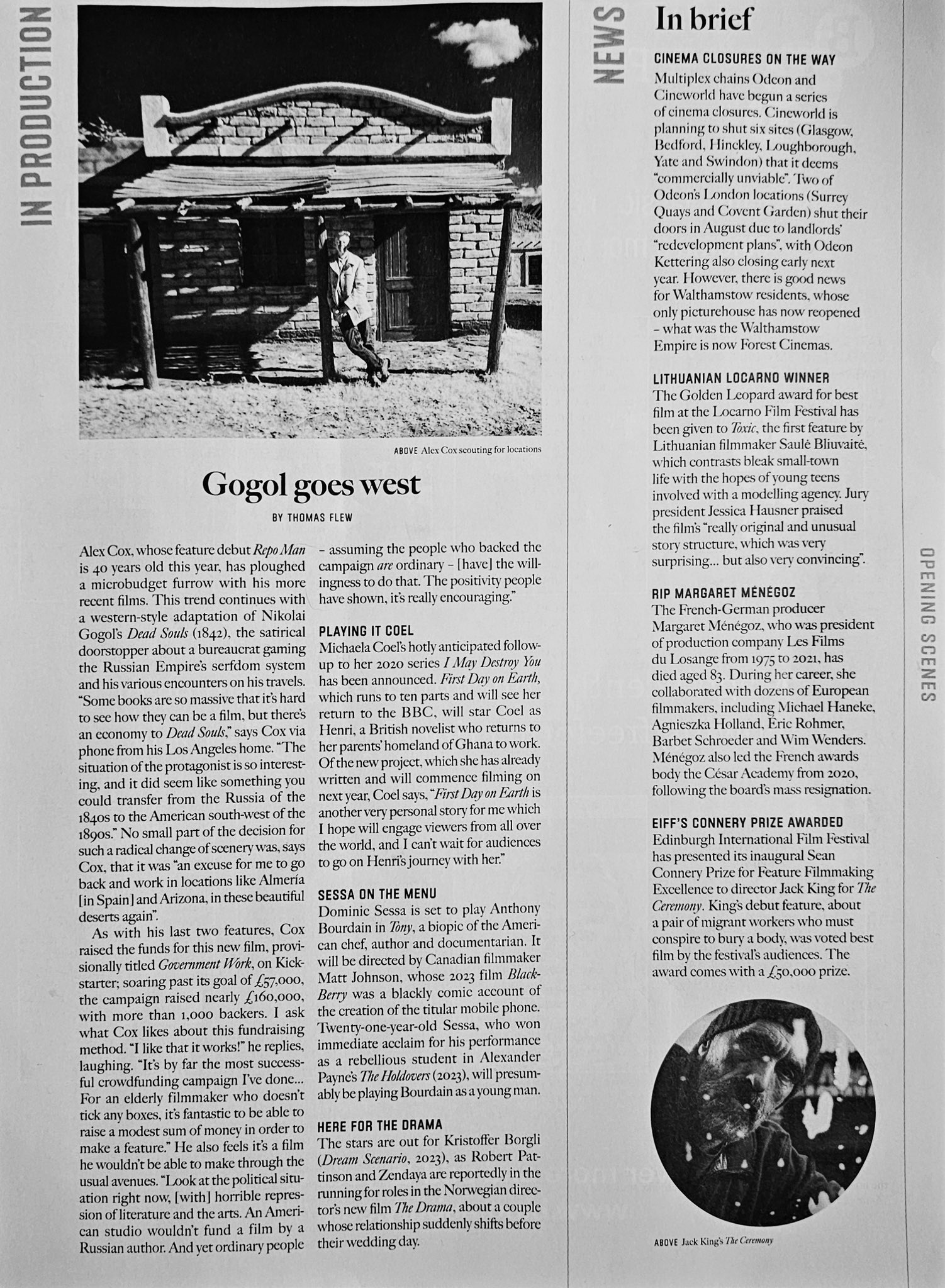
Alex Cox has (reportedly) made his final film: a Western adaptation of Nikolai Gogol's classic novel Dead Souls. The book follows a drifter in Tsarist Russia who travels from town to town collecting the names of serfs who've died since the last census was taken and are thus considered taxable property—i.e. "dead souls." Cox trades out the 19th-century Russian setting for the American Southwest around the same time and opts to play the main character himself.
The film was crowdfunded via Kickstarter (I contributed back in 2024) and went through a strange production journey. Portions were shot in the Almería desert in Spain at locations built for Sergio Leone's For a Few Dollars More (1965). The remainder was filmed in Arizona. Shooting ultimately wrapped in November of 2024, and Cox spent many months editing the film, working with his visual effects team to complete the project and sending out periodic updates to his patrons (according to one, the final product will contain a puppet flashback scene). The film has already played at a few festivals and will start its theatrical release in the U.S. on July 2 in Seattle.
Having read Dead Souls, it's not surprising that it would appeal to Cox. For one thing, there's a very self-referential quality to the writing. The narrator often speaks directly to the reader about the novel itself, calling to mind some of Cox's well-known postmodern touches: the generic food labels of Repo Man (1984), the intentional anachronisms of Walker (1987), Malcolm McLaren's finger guns and Sid Vicious' fantasy of shooting the audience in Sid and Nancy (1986). Reimagining a classic of Russian literature as a Spaghetti Western is a suitably offbeat and imaginative choice for Cox, and he's not the first punk to embrace this particular novel—it inspired a Joy Division song of the same name.
Cox is a big fan of Spaghetti Westerns—he attended Oxford University, Bristol University, and UCLA and reportedly wrote his thesis on the genre. His film Straight to Hell (1987) is an homage to the gunslinging movies of the 1960s. Dead Souls contains many nods to Sergio Leone in particular. In addition to being shot at locations built for For a Few Dollars More (which Cox tells me is his all-time favorite Western), it includes a title sequence done in the style of Leone's title designer, Iginio Lardani.
Cox is a middle-child of film history, born too late to be a "movie brat" yet too early to join the '90s indie explosion. His films are characterized by a singular vision and unique set of obsessions: ruminations on politics, examinations of the appeal of punk music, use of older stars (Harry Dean Stanton, Dennis Hopper, Derek Jacobi), subversion of genre tropes, and a dark, satirical sense of humor.
In our conversation, he discussed his remarkable, one-of-a-kind career and answered questions about Dead Souls' financing, distribution, and physical production.
The Film Stage: What made you want to adapt Dead Souls as a Western specifically? Why not a sci-fi or a crime film?
Alex Cox: The book lends itself to becoming a Western. Chichikov travels immense distances in a wagon across the open plain. He fetches up in small towns full of suspicious and gullible eccentrics. The ending of the first and only complete volume has the mysterious hero racing blindly through the night in his coach, uncertain of his destination, entirely exhilarated. This sounds like a Western to me.
Is it going to be an "acid Western" like Walker?
What is an acid Western? I think of a film like Zachariah or Greaser's Palace, where the plot is not a major element and the filmmaker perhaps attempts to recreate an LSD experience. Whereas Walker has a very dense plot and is largely based on real events and individuals. Taking place in Nicaragua and Mexico in the 1850s, it isn't really a Western. Its genre, I think, is the biopic. This can be a great form: a recent example is Konchalovsky's remarkable biography of Konchalovsky's remarkable biography of Michaelangelo, Sin. Dead Souls is more of a Western, though not necessarily acidic.
How did you deal with the historical research for the movie?
I enjoyed following the career of Johnny Behan from Tombstone via Yuma Jail to the Chinese Exclusion office in Texas. He is usually depicted as a bad guy who defied Wyatt Earp, but he was a much more complex and successful character. This film is the third time Jesse Lee Pacheco has played Behan!
How do you translate the institution of the Russian serf system to a more contemporary American context?
The Tsar freed some 23 million serfs in 1861. Abraham Lincoln issued his Emancipation Proclamation in 1863, but slavery didn't end until the conclusion of the Civil War: there were even slaves in the northern border states until that time. And unpaid labour continued to be enforced by the prison system, so in a way, slavery never went away in the U.S. Dead Souls is the story of a man who pays for lists of names: the names of dead serfs.
My film takes place in the southwest U.S. in 1890. In theory, there are no more slaves. But there is a definite exploited class, consisting of what the white Americans called "Mexicans"—even though many of them had lived in the southwest for generations—"Indians," and Chinese. The film's protagonist pays for lists of names of dead Mexicans. Why does he do this? What is the advantage to him in knowing the names and personal details of a despised underclass? You must watch the film to find out.
Dead Souls was left unfinished at the time of Gogol's death (it ends in mid-sentence). Did that present a challenge? Were you forced to simply write your own ending?
I've read that Gogol intended to write a trilogy. Volume one was about bad people; volume two was to be about good people; and volume three would be about paradise. As we know, he only published the first volume, though fragments of the second volume, which he burned twice, also survived. In the book, it isn't entirely clear why Chichikov does what he does. Clearly he plans to get some social or financial advantage. So the screenwriters' challenge is to decide what the protagonist really wants, to properly conclude the film. Fortunately, some of the fragments of volume two are really good, and provide additional inspiration.
Did you make pretty much the movie you wanted to make?
Yes. Originally I wanted to shoot the entire film in the Almería desert. But there was a glut of production there, and we ended up shooting one week in Spain and two in Arizona, at the Mescal Western town. The visual effects were done by Phil Tippett's team in San Francisco. I'm very pleased with the way it all turned out.
Is there anything in particular that you remember about shooting this that stands out?
Zander Schloss designing his own costume. Working for our Arizona DP Chance [Falkner] as he directed the Streets of Laredo scene: I was his AD and the necessary skills are quite different. Filming the immortal deserts of Tabernas with Ignacio. Mescal and El Paso. Every day at sunset.
I think of you as similar to people like Francis Ford Coppola and Steven Soderbergh: industry innovators who develop creative tactics for shooting on a budget and raising money outside the studio system. Is that done mostly out of necessity, or is it a conscious choice to give you more creative freedom?
Now, I bet you know the answer to that question. What do you think happened after I made Walker for a Hollywood studio?
Do you storyboard your films?
I storyboard the VFX sequences. Otherwise, we go to the set, have a rehearsal, and the DP figures out how best to shoot the scene.
I know you worked with Rudy Wurlitzer. Have you read his novel Nog? Do you feel it has any relevance to your work?
I've read all of Rudy's books. Nog was okay, though there wasn't enough of the octopus in it for me. My favorite of his novels is Slow Fade. It's an amazing book about his relationships with Peckinpah and the dharma trail. And the screenplay is every bit as good. That would have been a wonderful film to make. A pity Bertolucci and Jeremy Thomas didn't jump on it after they did Little Buddha. Of course, Slow Fade isn't a feel-good story. None of Rudy's great work is. And let me throw in a shameless plug for the fact that two screenplays we wrote—Body Parts and Out of Control—are to be published as one of those books with two covers. Like the Two Dollar Radio edition of Flats and Quake. Read one, turn the book upside down, and read the other!
Which current films interest you? Are there any that you've watched recently that have piqued your interest?
I greatly enjoyed Flow. I thought it was wonderful. Beautiful, surprising, astonishing, and entirely animal-centric. I would like to see more films like that.
You're known as a bit of a cult filmmaker. What's your relationship with your audience like?
Film is not the theatre. If you direct or act in a play, you have direct communication with the audience—every night, and twice on Saturdays. When you make a film, you let it go. You can never attend all the screenings, and there is no need to—the film is finished and making its way. Whereas a play, thanks to the immediacy of the audience and its clear reactions, can constantly evolve.
Is making films after 45 years still as interesting to you as it was in the beginning?
Yes! The same problems overcome by the same group of stalwarts, though their faces change.
Abel Ferrara once said that being a filmmaker is like being the Pope. You work until you drop. With this film coming out under the headline "Alex Cox's final film,"" are you feeling introspective at all? Are you looking backwards?
Certainly there's no incentive for a filmmaker to retire. Everyone has another project they would love to make. Why not pursue it? I called the Kickstarter campaign "my last movie." Is it? We shall see. I try to look backwards and forwards at the same time.
Dead Souls screens at Seattle's Central Cinema on July 2 with Alex Cox in person.
"DS Interview: Alex Cox Talks 'Dead Souls,' Westerns, and Punk Rock, by Forrest Gaddis (Dying Scene, 10/20/25): Director Alex Cox has been making films since the late 1970s, starting with his first short film, Edge City. After writing Repo Man in 1978, Cox finally sold the film to Mike Nesmith of The Monkees, who got Universal Studios to back the film. Cox hired punk rockers and punk bands, such as the Circle Jerks and the Untouchables, to populate his version of Los Angeles, a practice he would continue in his next few films: Sid and Nancy, Straight to Hell, and Walker.
Alex Cox's early films are cult classics among punk rockers, film students, and other seekers of the strange. However, in 1988, Cox was essentially blacklisted from Hollywood. Since then, he has been working outside the Hollywood system, opting to work independently and mostly on his own terms, raising funds as needed. If there's anyone who's body of work has kept the punk rock ethos through out his career, it's Alex Cox.
Cox has continued to present stories using his unique voice and take on genres; one in particular is Westerns. Cox has spent many years studying and presenting his interpretation of them. Whether it be in a more modern setting, as with the films Straight to Hell or Searchers 2.0, or period pieces with unexpected elements like Walker or Tombstone Rashomon Cox has done extensive work in the genre and continues to push its limits in new and unexpected ways.
We caught up with Alex Cox to talk about his new film Dead Souls, Westerns, and some of his older films.
Dying Scene ( Forrest Gaddis): Tell us about your current movie, Dead Souls.
Alex Cox: It's a Western, written by me and Gianni Garko, based on Gogol's Dead Souls, shot last year in Almería and Arizona with two crews, one Spanish, one American.
What drew you to adapt Gogol's Dead Souls as a Western and what themes still feel relevant?
I'm always looking for excuses to make Westerns, and Gogol's story, with its hero crossing vast distances for mysterious reasons, is a natural. What are its themes? What I drew from the story was the commodification of human beings—whether they be serfs, or slaves, or prisoners, or "illegal" workers or "collateral damage"—but the book no doubt has many other themes. Since it isn't finished (Gogol only completed volume one of three) we don't know what Chichikov's purpose was, or how it all ends.
What attracts you to the Western Genre?
The desert! Some fine Westerns, such as The Great Silence, don't take place there. But most of them do.
Is there any part of the Western Genre that doesn't work for you and what have you done to make that aspect your own?
The worst aspect of the Western, and all narratives, is that it can be reduced to a story of good versus evil, where good (i.e., middle-class capitalism in support of railroads and genocide) triumphs. Good Westerns usually do not do this. Some examples are The Searchers, Kirk Douglas' Posse, Sergio Leone's films, A Bullet for the General, and Sollima's, Questi's, Petroni's, Lizzani's, and Peckinpah's Westerns.
You've said this may be your last film. How has that shaped your approach to 'Dead Souls'?
I called the Kickstarter campaign 'my last movie' to encourage people to support the project, in the same way as The Who have announced multiple farewell tours. Will it be my last movie? Possibly. I'm 70 years old and raising money for films is very time-consuming.
How did crowdfunding shape the creative process compared to traditional financing?
If you work for a single financier they will most likely have a say in the project, particularly in terms of casting. With El Patrullero, the Japanese executive producers gave us complete casting freedom. Usually, that isn't the case—unless the budget is so low that you can't afford 'star' actors. In the case of a $250K crowdfunded film, no one is pushing you in that hopeless direction.
Can you tell me a little about how you got into punk rock? How active in the LA punk scene were you while you were at UCLA?
Devo was the first punk band I saw, in a basement in Hollywood off the Strip. Then there were all these LA bands—the Plugz, the Screamers, X, Black Flag, Circle Jerks, Wall of Voodoo, GoGos (they were a punk band at first, and not all glamorous). More bands visited. I saw 999, Gang of Four, Talking Heads, and The Clash. The Sex Pistols were supposed to come to LA, but they broke up in San Francisco, the day before. Happy times.
'Repo Man' and 'Sid & Nancy' are classic punk rock movies. How did punk ideology influence the storytelling and aesthetic of your films?
You would have to ask a film critic. I don't analyse the stuff—just churn it out.
Was there any pushback from the 'Repo Man' script, in regards to it skewering American culture, but being written by someone from England?
Michael Nesmith, the executive producer, liked the script a lot. I don't think the execs at Universal ever read it.
I know 'Repo Man 2' is in the works. Is any of that script based on 'Waldo's Hawaiian Holiday' or connected to 'Repo Chick'?
Neither one. Right now Repo Man 2: the Wages of Beer is just a mouldering press release. But who knows?
You've worked with musicians like Joe Strummer, Courtney Love, Elvis Costello, and The Pogues. What did they bring to a set that trained actors could not?
The ability to play musical instruments! Some actors can't do that but all musicians can. On Dead Souls I worked with a number of actor-musicians—Ed Tudor Pole, Sarah Vista, Zander Schloss, Javier Arnal, Dick Rude. Some actors are trained, some are not. Some people have a natural acting talent, a talent for impersonation, and telling stories.
You've said punk rock wasn't just about music, it was about "bringing down the government." How does that manifest in your films now?
When did I say that? And which government? The funny thing is that punk rock burst forth in rebellion against the Labour Government in England and Carter in the US. There were definitely many things to complain about in the late 1970s, but we rebel punks had no idea how bad things were about to get.
Is there an era of your filmmaking you consider your best, and a film from that era?
Again, that's a question for somebody else to answer. I like almost all the films I made. There was very good source material—Borges, William Walker—and I worked with some very good writers—Rudy Wurlitzer, Lorenzo O'Brien, Tod Davies, Thomas Middleton...
Do you feel your films are misinterpreted by the audience? Which one do you think is the most misunderstood?
I hope they aren't misinterpreted. I try to be pretty clear about things and to make the story comprehensible to the viewer. If a film has a point, then you want that point to come across. I think Sid & Nancy may be a failure in that regard. Abbe Wool and I wanted to make a salutary tale about a frivolous pair who betrayed the punk ethos (Sy Richardson's speech in the methadone clinic is what the film was all about) but a sentimental stew ensued.
Are there any movies or projects that didn't work out that you wish had?
There are a couple of scripts I wrote with Rudy—bBody Parts and Out of Control—bwhich I would still love to make. They are 1980s action thrillers set in Tucson and Central America. Both are coming out as a book soon—bone of those double novels you turn upside down to read in both directions.
Where can we buy your books or films?
Where to buy my books? I always check Thriftooks and A Libris, or go to the bookshop in town. Or the library! You can order new books or discs online directly from the publisher (Oldcastle / Kamera books in my case, disks from BFI in England and Kino Lorber in the US). No Amazon or its subsidiaries (AbeBooks etc.)
A number of Alex's films are also available on the Criterion Collection. For updates on all things Alex Cox. Check out his website, here.

|
Mr. Cox is currently in London himself, hosting portions of BFI's Moviedrome: Bringing the Cult TV Series to the Big Screen.
"Careful What You Pray For" is from the band's "Bloodgrass 3 & 4" album, check it out HERE.

Photos by Mark Parascandola via Instagram
Alex Cox's Last Movie in Almería, by Mark Parascandola (Once Upon a Time in Almería Blog, 11/12/24): Alex Cox is currently at work on what he is calling his 'last movie.' And, of course, it involves shooting in Almería. Last month I had the extraordinary opportunity to visit the set.
Cox has been drawn to Almería since he was a teenager outside Liverpool. As he explained in his introduction to my photobook Once Upon a Time in Almería, he made his first trip there in the early 1970s, by bus, train and bicycle. Cox would return in the 1980s, bringing along a film crew and a cast of musically-inclined friends, to make Straight to Hell. For twenty years he maintained a house in Tabernas.
Thus, it's no surprise that Cox would want to return here for his last hurrah. The original plan was to shoot the entire film in Almería, but as the province is experiencing a resurgence in film production, everything was booked up for the rest of the year. In the end, the crew spent four days shooting in the area, making use of two historic film sets leftover from the 1960s.
Much of the cast and crew came together for the first time on Saturday evening during the Almería Western Film Festival to participate in a read-through of the script under the working title Dead Mexicans. The story is loosely inspired by Gogol's Dead Souls but is set along the US-Mexico border. The cast includes familiar faces from previous Cox productions, including Del Zamora, Edward Tudor-Pole, and Zander Schloss.
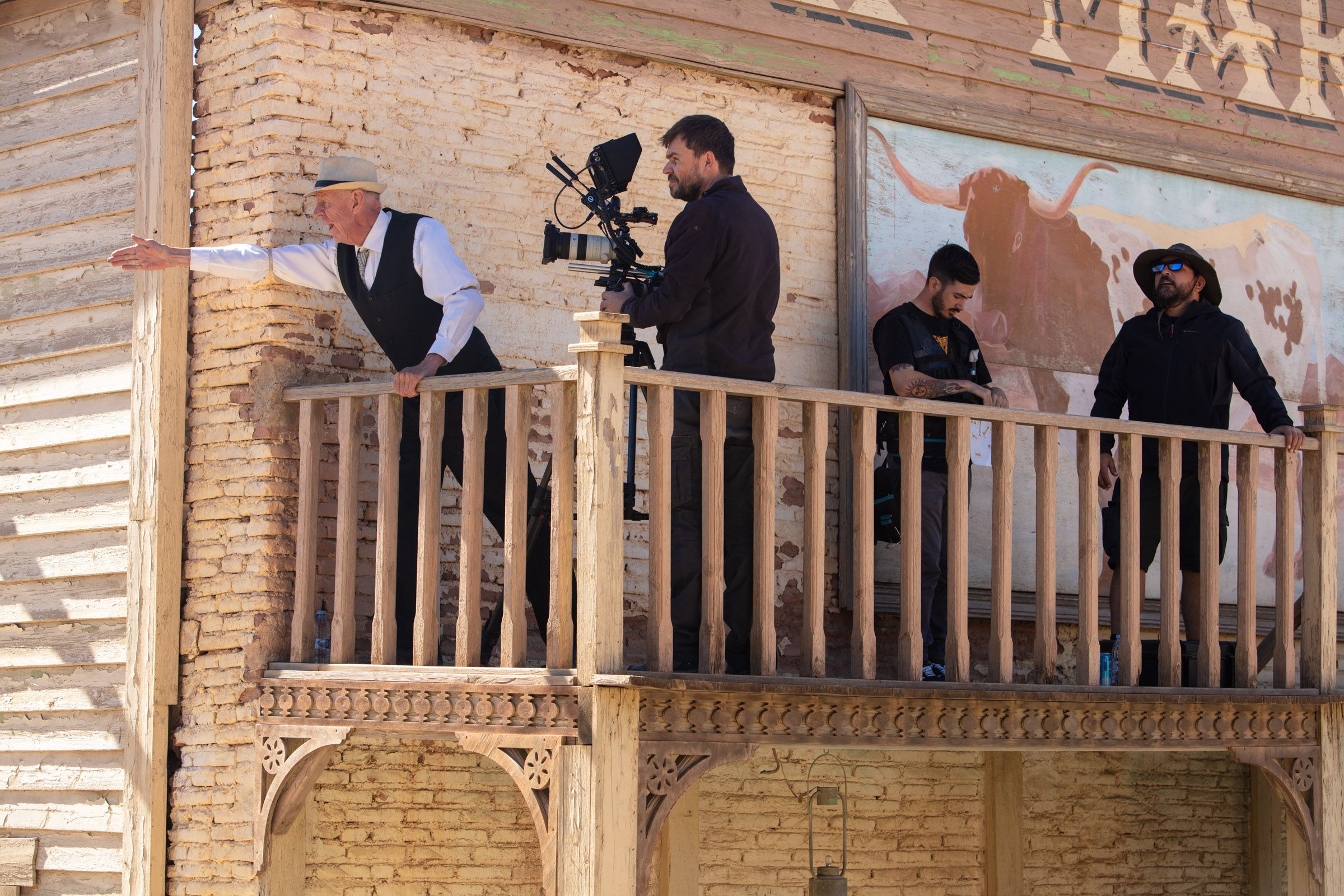
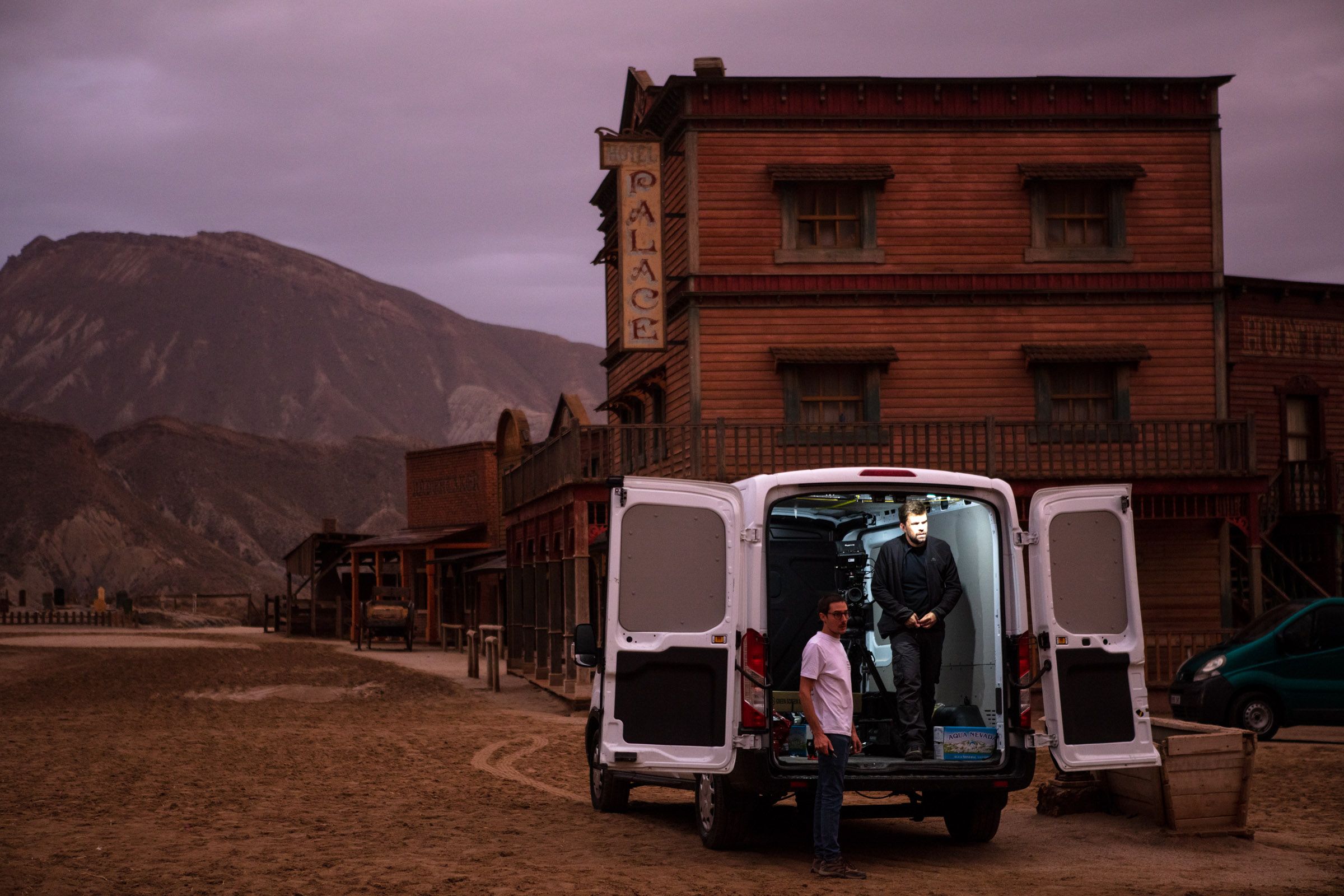
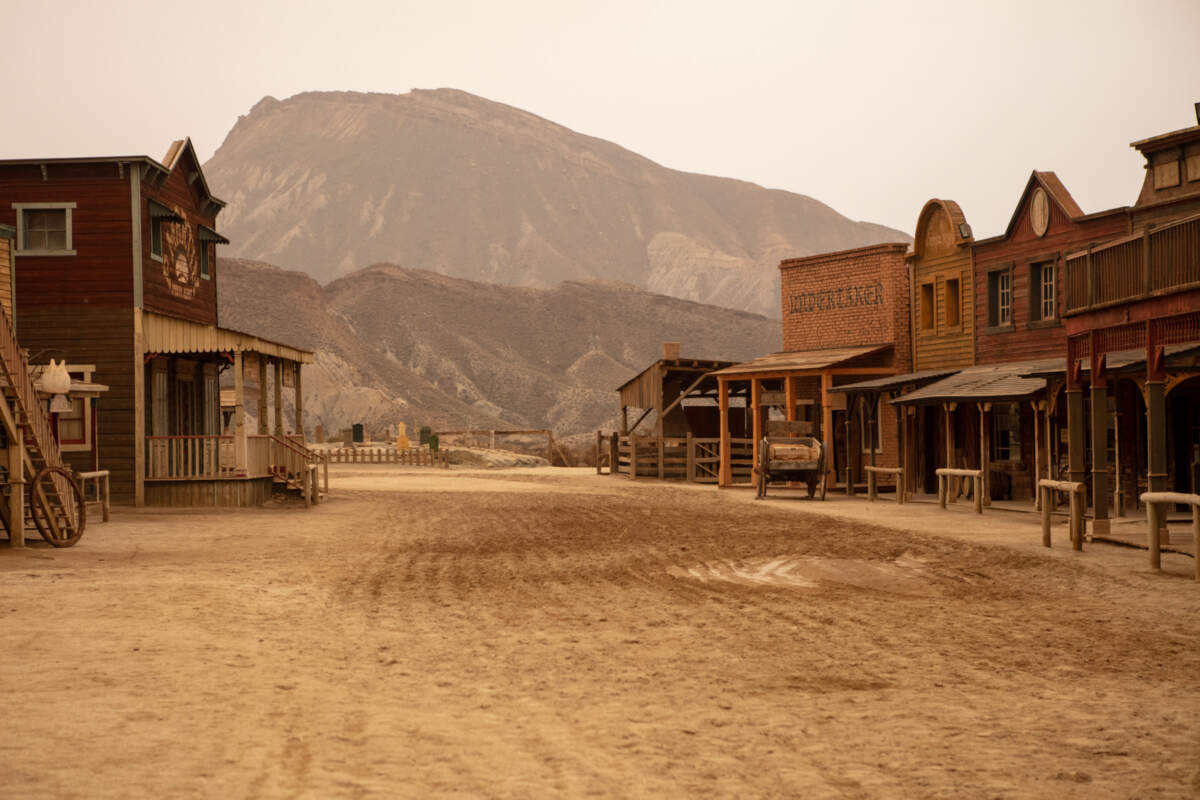
On Monday morning the sky was unusually cloudy. Shooting began at Oasys Mini-Hollywood, a western theme park built around a movie set first constructed for Sergio Leone's For a Few Dollars More with Clint Eastwood and Lee Van Cleef. The old west town was quiet and empty, apart from a handful of extras wandering about. (The crew would return later in the week when the park was open to tourists, having to shoo away curious onlookers and pause filming during the mid-day stunt show.)
It was inspiring to watch Cox and his outstanding, mostly Spanish, crew at work. Guillermo de Olivera of Zapruder Pictures handled production for the shoot in Spain and Almería-based Impossible Makers were brought in for prop and set design. Cox, who turns 70 in December, appeared as energetic as ever bounding around the set and exuding an infectious enthusiasm. Cox has an eye for seeing potential in others and finding roles for them in front of or behind the camera. Indeed, if you hang around long enough you just might end up in costume in front of the camera.
The final scene took place alongside the deteriorating remains of a fortress first built for the movie El Condor (one of the Kickstarter campaign rewards was to have your name on a cemetery cross). In the late afternoon sun, the crew moved quickly to plant wooden grave markers in the ground, using rocks to reinforce them against the harsh winds. Once the set was ready, a few quick takes before the sun went down, and it was a wrap for the Almería production.
Cox and crew have now moved on to Arizona to finish shooting at the Mescal film set outside Tucson.
 |
 |
 |
 |
 |
 |
 |
 |

|
Diego Martínez—Redactor, Diario de Almería
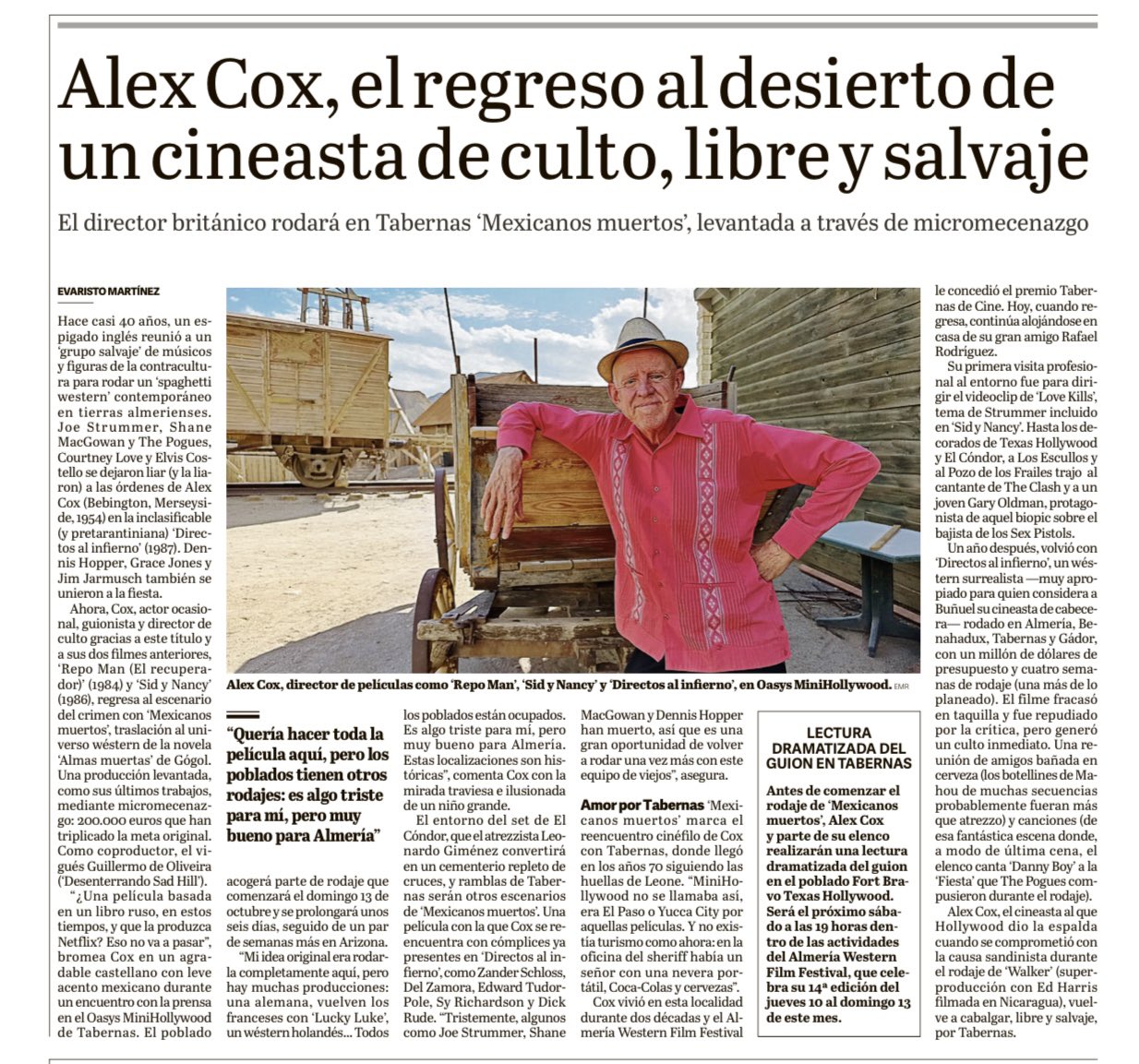
Tabernas ha acogido el rodaje de la película Dead Mexicans, dirigida por Alex Cox y producida por Guillermo de Oliveira. Tras cinco días de grabación en el Desierto de Tabernas la película trasladará su filmación al Desierto de Saguaro en Arizona. Allí rodarán en poblado Mescal Movie Set, conocido por películas como El fuera de la ley, Tomsbtone o Rápida y mortal.
Mexicanos muertos es una adaptación en clave de spaghetti western de la novela del ruso Nikolai Gogol, Almas muertas. La película está escrita, dirigida y protagonizada por Alex Cox. En el reparto destacan algunos de sus colaboradores habituales como Del Zamora, Ed Tudor Pole o Zander Schloss a los que se pudo ver en Tabernas.
En el equipo destacan almerienses como Leonardo Giménez (arte y vestuario), Nicolás Fernández y Adrián Sánchez (ayudantes de cámara) o Javier Arnal que interpreta dos breves papeles en la cinta. Ignacio Aguilar, que ya trabajó en el largometraje Rabioso en Almería hace apenas unos meses, ha repetido como director de fotografía.
Oasys MiniHollywood, Malcamino's o el propio Ayuntamiento de Tabernas son algunas de las empresas y entidades locales que han colaborado con la producción. Su estreno está previsto para 2025. En cuanto al reparto de su nueva película, Cox subraya que "en esta película hay varias personas que ya salieron hace casi 40 años en la película que ya rodé aquí. Desgraciadamente algunos actores ya no están."
Cox explica que las primeras escenas que había rodado de su nueva película han contado con un gran número de personas como figuración, aunque la parte final de la película se iba a rodar en Arizona. También se quejaba de la triste desaparición en toda la zona desértica de Almería de las pencas. "Yo conocí Tabernas como el lugar de las pencas, y se han perdido casi todas debido a unos bichos que las han destruido. La película pasa de un desierto muy seco a un desierto donde aparece algo de verde."
|

His new film proposal is based on the novel Dead Souls, by Nicolai Gogol, to make a "Western version" of an ironic and mysterious story that takes place in 1890 in Arizona. The film will be titled Dead Mexicans.
To portray this picture, Cox intends to shoot in two locations: Tucson (Arizona) and, of course, the province of Almería, where MiniHollywood Oasys will be one of the main sets for filming in the province.
And to learn more about the film and get to know this iconic and eclectic director better, MiniHollywood Oasys held a round table, moderated by Carlos Vives (La Oficina Producciones Culturales) and composed of José Díaz (mayor of Tabernas); the filmmaker, Margaret Von Schindler and the journalists, Carlos Juan and Manuel Carretero (Canal Sur); Pepe Cuenca (Dipalme Radio); Evaristo Martínez (La Voz de Almería) and Diego Martínez (Diario de Almería). The production of this table was carried out by Leonardo Giménez (Armería & Atrezzo Leonardo); Andy Arche; David Miralles & El Indaliano (Un Nuevo Renacer Producciones), Diego Pérez (Proyecto Cine TV); Pablo Torres (De Torres Producciones) and Canal Sur Almería.
Alex Cox was surprised not to be able to shoot the entire film in Tabernas. "I have found that the villages are occupied with other productions. There are many shootings at the moment and others in perspective. This means that there is no possibility of shooting the entire film here, but we will be in Tabernas for a few days and then we will go to Arizona to shoot the rest of the film."
Regarding the cast of his new film, Cox stressed that "in this film there are several people who already appeared almost 40 years ago in the film that I already shot here. Unfortunately, some actors from that time are no longer here."
At the beginning of the 70s, Alex Cox visited for the first time the locations of the films that Sergio Leone had shot. "Leone's films from that era are charming and still have something special about them."
Cox explained that the first scenes he will shoot of his new film will feature a large number of people as figuration, although the final part of the film will be shot in Arizona. He also complained about the sad disappearance of the stalks throughout the desert area of Almería. "I knew Tabernas as the place of the stalks, and almost all of them have been lost due to some bugs that have destroyed them. The film goes from a very dry desert to a desert where some green appears. In Almería I will shoot for five days and in Arizona for two weeks."
"I really wanted Gianni Garko to work on this film, but due to his age, I can't ask him to make a film in such a short time," said Cox, who lived for many years in Tabernas. For this reason, Cox stressed that "Almería Western Film Festival is a great support for filmmakers. What's more, the Festival introduces Tabernas and Almería to many filmmakers who do not know this wonderful environment."
"I really like the Festival that people who come can enter for free to see the film. You don't need to pay a lot of money, people are invited, and I think the atmosphere of the Festival is very beautiful, and the people who come enjoy it," he said. He was always fascinated with the landscapes of Almería, and more specifically the desert of Tabernas. "A good film is an invitation to get to know the place where it has been shot," says this brilliant filmmaker.
"When I left Tabernas I was sad, I didn't want to leave the house. I wanted to have my little place in Tabernas. Tabernas is a very special place, and I took many walks in the desert. I now live in Oregon with my wife and three dogs," recalls Alex Cox. The filmmaker also remembered Joe Strummer, leader of The Clash, of whom he said that "he was an extraordinary person with great energy. Sadly he died very young. It was really a luxury that I worked on the film Straight to Hell that I shot here almost four decades ago." I remembered that film that brought a cast of actors of great projection such as Sy Richardson, Joe Strummer, Dick Rude and Courtney Love and also appeared Dennis Hopper, Grace Jones, Elvis Costello and Jim Jarmusch. Members of The Pogues, Amazulu and Circle Jerks are also in the film. The film's title is based on The Clash's 1982 song of the same name. "We filmed in the middle of August in Almería, with a lot of heat, and it also coincided with the Almería Fair. I remember the Chochona song which had a great impact on The Pogues," says Cox. "We had so many ideas that we had to extend the filming time, and we spent four weeks."
"From REPO MAN to DEAD SOULS: A Lifetime in the Cinema of Alex Cox," by Jonathan Marlow; Hammer To Nail, September 3, 2024
HtN: There are far too many corporations benefiting from never-ending wars. [Granted, more-than-one is already too many.] Connecting Repo Man to your forthcoming film, Dead Souls or My Last Movie or whatever it will be called...
AC: My Last Movie is the name of the campaign to raise the money. The film will have a different name.
HtN: That is what I'd suspected. Title to-be-determined!
AC: We'll see what it is called when it's done.
HtN: Does that the same sense of frustration with society permeate the new project? As it seems to be a subtext in all of your films that I have seen (which is, essentially, all of them).
AC: I was talking to one of the actors last week and he said that he thought that the theme—or what united all the characters in the script—was desperation. That is actually a good observation because certainly the protagonist is motivated by desperation but it hadn't occurred to me that all the other characters were as well. It is a little different from the book in that sense because not all of the characters are desperate. I mean, [Pavel Ivanovich] Chichikov in the book is desperate. He wants to acquire a whole load of serfs to advance himself in society. [spoiler] He is going to conceal the fact that they're dead, though. All of the people in the script are kind of past the idea that they're going to advance in society. It is a more existential struggle and they're engaged in that.
HtN: What are the advantages of taking the novel Dead Souls and putting it in the milieu of the Western? Not that I'm disagreeing with the notion.
AC: It is interesting because the author [Nikolai Gogol] was considering it as the first part of a trilogy. There were supposed to be three Dead Souls books. The first one was about bad people. The second was about good people. The third one was to be about paradise. But he only ever wrote the first one. He had two attempts of writing the second and tore them up and burned them. Only fragments remain. He never started the third book at all. It is obviously easier to write about bad people than good people! Naturally, it lends itself to a cynical tale told in the American Southwest in 1890. It is also an excuse for me to go to those locations. I love those locations! I love to go to Arizona. I love to go to southern Spain and be in that desert. Making a film affords you the opportunity to do that.
HtN: You're saying that you write your scripts based on where you want to be?
AC: Definitely. That is why I made Walker. I wanted to make a film in Nicaragua! We made Repo Man because we were in Los Angeles. We had to make a film in L. A., you know?
HtN: Not Antarctica, presumably.
AC: No. I'm not going to Antarctica. No. I'll leave that for others.
HtN: This experience of crowdfunding [full disclosure: these two fellows collaborated on Tombstone Rashomon not quite a decade ago, although the contributions of the interviewer were of modest proportion compared to the efforts of the interviewee], how has it been for you overall? Do you feel like these nontraditional routes of film-funding have given you a considerable amount of freedom?
AC: It has been the most amazing response. We made more money than we expected and I think everybody was surprised. Even Kickstarter seemed surprised. They weren't expecting that we would get as good a response as we did. It was very encouraging!
HtN: To what do you necessarily attribute that success? The common routine is that recent crowdfunding campaigns have found it harder to generate comparable interest than in the past. Early-on, many people had great successes and then found it more difficult to go back to that well in subsequent campaigns.
AC: Surprisingly enough, we've inverted it. I think it has to do with people being cineastes, like Kareem standing in that that queue to see Kiss Me Deadly. They want to see what they want to see. For the Kickstarter campaign, more people wanted the DVD or a Blu-ray than wanted a streaming film. A lot more people are interested in the physical-good itself.
HtN: It is a pleasant change that folks see the value in having access to something when they want rather than relying on some third-party to provide it.
AC: Relying on some corporation to host the thing online or having to pay a monthly fee just to be able to access films that you like. Why not go and buy the Repo Man DVD?
HtN: Exactly right. For this production, you've brought some of the usual suspects back together, like Phil Tippett and so forth.
AC: Many people. Some of the actors from Repo Man. Some of the actors from Tombstone Rashomon. Crew from all over the place. One crew in Spain and another crew in Arizona. The Spanish crew is all firmed-up. We shoot in October. The Arizona crew is still coming together because people in the industry are hoping that some big projects will suddenly happen in the fall. We have some time, though. We will be shooting there towards the end of November. We don't need to be crewed-up yet.
HtN: You should have a firm grasp on the direction of things after the Spain shoot.
AC: Once all that is in the can, so to speak. That should make everything clear.
 |
 |
"Go West: Alex Cox on making his last movie and the re-release of his first" by Michael J. Casey (Boulder Weekly, 28 Aug 2024): Former CU professor and current filmmaker Alex Cox is gearing up to make his final feature.
"I don't want it to be my last movie," Cox says. "It's just that it very well may be the case. It's been seven or eight years since I've made a film—nearly 10 years since I've made a feature. Well, 10 years from now, I'm going to be 80. How likely is it that I will make another film? I don't know."
Of course, Jean-Luc Godard was directing into his late 80s, and Portuguese director Manoel de Oliveira was 104 when his last feature came out. To that, Cox retorts with a laugh: "That's a bit excessive, don't you think?"
Laughter comes easily to Cox. Anyone who has seen his work knows that.
Cox burst onto the film scene 40 years ago with the sci-fi punk rock comedy Repo Man, a movie that continues to enchant and entertain. CU's International Film Series will host a free 35mm screening on Sept. 5, just two days after The Criterion Collection releases a newly restored 4K UHD version.
"It looks really good," Cox says of the new transfer. "It just looks so pretty."
Pretty might not be the word that first comes to mind about a movie loaded with world-weary repo men and unkempt punks. But Repo Man was shot by "one of the great cinematographers," Robby Müller, who imbues every scene, every shot, with a loving kind of poetry.
Repo Man was just the beginning. It launched Cox's career, which currently encompasses a dozen features, some shorts, several books and a stint teaching cinema studies at CU (where he made Bill the Galactic Hero with his students). The movie also kicked off a lifelong collaboration between Cox and several players, many of whom will be in his next, maybe last, movie.
"Sy Richardson, Del Zamora, Zander Schloss," Cox says, listing off participants. "The movie is a combination of people I've known since Repo Man and people I worked with on Tombstone-Rashomon. So it's like my first film and the last film I made combined."
The last picture show
Like Tombstone-Rashomon, Cox's latest endeavor is crowdfunded. What's different is the attention.
"Normally, if I was doing my last movie, that would end up in Hollywood Reporter and in the Guardian in England," Cox says. "But because of the basis of the piece, it hasn't been mentioned anywhere in the mainstream media."
That basis: the 1842 Russian novel by Nikolai Gogol, Dead Souls.
"In terms of alternative media and in terms of the public reaction, the response to this has been far better than either of the crowdfunders I did," he says. "Which really encourages me. Because, although the governments of the U.S. and England are really trying to gee up the population and get them ready for a war with Russia, there's no support for it at all in the population."
That's how Cox came to Dead Souls and Russian literature in the first place. The more "we were being told we should hate the Russians and despise Russian culture," the more he became interested in what the Russians had produced. So Cox started with Dostoevsky and Tolstoy and found them "quite amazing." Then came Dead Souls.
"It's so lively, so interesting, the characters are so good," he says. "This was the thing that you could turn into a Western."
'Miracle enough'
Cox is passionate about cinema, but his passion for Westerns, particularly Italian Westerns, goes even deeper. As a graduate student, he wrote a survey of the genre, which he reconfigured into a book-length study in 2020: 10,000 Ways to Die: A Director's Take on the Italian Western.
It's an obsession that extends to location, particularly Almería, Spain, and the nearby Tabernas Desert, where many Italian Westerns were filmed. In 1976, Cox stole a 16mm Bolex camera from school and went to Spain to photograph the still-standing sets for his short film The Black Hills. Ten years later, he returned to Almería as a full-fledged filmmaker with a cast of musicians for his punk rock homage, Straight to Hell, which he shot using sets constructed for 1971's The Valdez Horses. That set has since "vanished."
"Straight to Hell was an adobe town, and it has, over the years, melted back into the earth," Cox says. "But adjacent to that location is the town [Sergio] Leone built For A Few Dollars More, where we're shooting."
Leone built the set as a double for El Paso. In a nice hat tip to the maestro, Cox will use the location as the same West Texas border city for his movie.
"The title is in flux," Cox says. "I was going to call it Dead Mexicans, and maybe I still will call it Dead Mexicans, but that might give offense to somebody somewhere. So we have an alternative title, which is Government Work."
Cox hopes to have his new and possibly final film done by the middle of next year. Then he'll "try to get it into some good festival" and see where things go from there.
"You don't know what's going to happen," he says. "You have no idea. Just making the film itself is miracle enough."

"The Hard Road: Alex Cox on Crowdfunding Success and a Life in Independent Filmmaking," by Matt Zoller Seitz, July 28, 2024 (Roger Ebert.com).
Alex Cox burst onto the film scene 40 years ago with Repo Man, a science-fiction satire starring Emilio Estevez and Harry Dean Stanton, with a theme by Iggy Pop and a soundtrack heavy on punk rock. He went on to make the music biopic Sid & Nancy, the modernized spaghetti western Straight to Hell, the political satire Walker, the minimalist character study Highway Patrolman, the Jorge Luis Borges adaptation Death and the Compass, and the Jacobean-styled The Revengers Tragedy, loosely adapted from the same-named play. With each new project, Cox moved a bit further outside of the mainstream. He hasn't made a traditionally funded independent film since Revengers in 2002.
Cox's latest is a crowdfunded project that ends its Kickstarter campaign July 29. Though puckishly titled My Last Movie, it's "a Western adaptation of Nikolai Gogol's Dead Souls which takes place in southern Arizona and Texas in the 1890s and will be shot in Spain and Arizona, and it's a super low-budget film." It's his third crowdfunded feature in the last 20 years, the other two being Bill, the Galactic Hero, based on Harry Harrison's novel, and Tombstone Rashomon, which retells the story of the gunfight at the O.K. Corral from multiple perspectives. I talked to Cox about the new movie, the evolution of independent filmmaking during the last four decades, and his definition of the word success.
Q: "So, how literally are we supposed to take the title My Last Movie?
COX: "Well, I mean, it could be my last movie. I haven't made a movie for nearly 10 years, you know. In another 10 years time, I'm going to be nearly 80. So there's a possibility that it will be my last movie."
Q: "The original funding goal was $75,000. And you've exceeded it, right?"
COX: "Oh, yeah. That [budget] was to make the film with glove puppets. If you have real actors, you have to pay them more."
Q: "What was it about this material that appealed to you?"
COX: "It's just a great story. It fascinated me that 'Dead Souls' is the first part of what Gogol intended as a trilogy, but he could never even complete the second book. He destroyed the second draft [of the second book] multiple times and never even got into the third draft. There are fragments of the second draft, including the miserable childhood experiences of the protagonist, which are just great. and we've included those in the script as well."
Q: "How do you transplant an 1842 Russian novel to the United States and turn it into a Western?"
COX: "The book is about a man who is acquiring the names of dead serfs. The book was written during the [era of] serfdom, which I guess you could say was equivalent to slavery and that still existed in Russia when Gogol wrote the book. The year that the the American Civil War began, serfdom was abolished in Russia. So Russia actually preceded the United States in abolishing slavery by a few years. At the time that serfdom existed, it was possible to acquire a large number of serfs, and if you acquired enough—I don't know exactly how many you had to have—you could be an aristocrat of sorts. Maybe you'd even be a prince, who knows? And so the protagonist of 'Dead Souls', Chichikov, is acquiring serfs. but because he's doing it on the cheap, he's actually acquiring the names of dead serfs, who he then going to present to the requisite authorities in order to acquire glory in Czarist Russia. My protagonist is acquiring the names of dead Mexicans, because he has a way of turning the names of dead Mexicans into money, or thinks he does."
Q: "Interesting. I can already see that this unmade project has a lot of similarities with previous work that you've done, including the sort of purgatorial aspect that some of your some of your films have, and also the sense that morality is merely an abstract construct for a lot of people."
COX: "When Gogol was trying to go about writing the three books, the first one was supposed to be about bad people, the second one was supposed to be about good people, and the third one was supposed to be about paradise. But he couldn't even get the second one completed, because it's much easier to write about bad people than good people. It's also more entertaining and much more dramatic. And imagine writing about heaven—how boring that would be, you know?"
Q: "Hell is definitely more cinematic."
COX: "And more literary as well. It's more interesting and more painterly. I mean, there are lots and lots of paintings from the Middle Ages about Hell, but there aren't as many paintings of heaven."
Q: "How long did it take for you to decide, 'I'm going to have to fund these movies some other way, because the system as it stands is not giving me what I need'?
COX: "It used to be back in the olden days, 20 years ago or more, you would fund a film from sales. You'd make a domestic sale and you'd make foreign sales. You'd do this via a sales agency. Sometimes, you know, a production company or a studio would fund the film and then distribute and then and then sell it later to a distributor. But that model of funding films seemed to become increasingly difficult and increasingly rare and also very anodyne. The type of films that were getting made via that model tended to be romantic comedies, and romcoms didn't seem like a very interesting possibility to me. And then my friend Phil Tippett crowdfunded the first third of his film Mad God and I thought, Wow. When Phil did that, I thought, This is the way to go."
Q: "You had a kind of a remarkable and in some ways unlikely run in the '80s and '90s where you were able to get these really uncompromising films funded and seen. What has changed to make it harder?
COX: "The early '80s was kind of the end of the '70s, and the '70s was the continuation of the '60s, and there was still a movement of independent film then. In those days, there was what they called the New American cinema, which included people like Monte Hellman and Dennis Hopper and Bob Rafelson and Hal Ashby. There were these very, very interesting films being made often by American directors and their equivalents in Europe, and also in Britain, with people like Lindsay Anderson. It was a fantastic time to be making films. And at the time, conventional entities like studios and television companies were interested in making feature films."
"But another thing is, when I was doing them back then, they were negative pickups for the studios, and the studios didn't have anything to do with the production of the film, and that was part of the appeal as well: it was a way for the studios to get certain kinds of films made but avoid working with the unions. I mean, we didn't think of ourselves as union busters when we were making Rep Man, but we were. The negative pickup deal was also a way for [studios] to learn how to make 'independent films.' Universal would then go on to invent a thing that was like an independent film company—called Focus Features, say—which was totally studio-owned but made 'independent films.'"
"Then the industry changed, because once the studios figured out the mechanics of making a lower budget independent film, the last thing they wanted to do was work with independent filmmakers, you know, because they much prefer to work with dependent filmmakers. Then independent filmmakers went off on a different route, and for a little while films were funded by record companies or by TV companies. Then we went the route of trying to divide the cost of the production between the domestic production company or distributor and foreign sales. When that dried up, then came crowdfunding."
Q: "I've seen a lot of really interesting super low-budget films in the last decade or so, but it seems like their problem is always getting seen. How do you break through the noise?"
COX: "I wonder as well. The means of production are within the hands of the filmmaker now that we can shoot on video rather than on celluloid. It's much cheaper to make a film in that sense. But distribution is another matter. You know, I made a film for Roger Corman called Searchers 2.0 and Corman had plenty of money, but he didn't have a distribution company. Distribution of the finished film was dependent on who Corman could find to distribute it."
Q: "I remember that one. It was made for, maybe not used-car prices, but trailer home prices."
COX: "Yeah, yeah—I think that one was done for about $200,000. That is because $200,000 was the [Screen Actors' Guild] super-low budget level. If you wanted to get SAG actors at the lowest possible rate, then your budget couldn't exceed $200,000, and so that became the top level for super low-budget films."
Q: "What are you doing at the moment, just as your regular gig?"
COX: "Oh, I don't have a regular gig anymore! I mean, I never really had a regular gig at all. Except when I was teaching at Colorado University-Boulder—that was a regular gig. I taught at CU Boulder for four years. That was the only full time job that I've ever had. Everything else has been project by project. Sometimes I do commentaries for DVDs or make little videos to present DVDs. For a while, I was introducing films on the BBC in England. But I've never really had a proper job. My wife made me get a job at CU Boulder because she said we needed to make money, we needed to have a regular income, and I could only think of two jobs that I was capable of doing. One was a gas station attendant and the other was a university professor."
Q: "What's happening with the Repo Man sequel that we heard about earlier this year?"
COX: "Oh, I've been doing that for a long time. Every 10 years I write a new script because every 10 years things are different. This is like the fourth Repo Man 2 that I've written in the last four decades. And I'm still trying to raise money for it. The producer is Lorenzo O'Brien, who produced Walker and who wrote and produced Highway Patrolman. He was also the producer of the series Narcos. The lead actor, if we're able to get him, is Kiowa Gordon, who I like very much. We are constrained by only having the domestic rights to the United States Repo Man sequels. Remakes and series [rights] reverted to me about four years ago, but we don't have foreign. So [to make a sequel] we have to find an investor who will go for a US-only distribution [deal]. In theory, that would be a good deal, because the US is by far the biggest market for the Repo Man phenomenon."
Q: "So do the terms of the original contract mean you could make a Repo Man sequel but you couldn't show it outside of the United States?"
COX: "We [could, but we] would have to sell it to Universal [first], because they own the foreign rights to a Repo Man sequel."
Q: "In theory, could Universal do a Repo Man sequel with some other director and only show it internationally, not within the United States?"
COX: "Ironically, because of my contract, the only person who can direct a Repo Man sequel is me, so they'd [still] have to buy the foreign rights!"
Q: "It all sounds very complicated!"
COX: "It is complicated, isn't it? But we are pursuing some interesting possibilities of finding some way that we can fund it, just from the US distribution [rights]. But the thing does not exist yet, except as a screenplay."
Q: "How many people need to see a movie for you to feel as if you succeeded overall, in whatever sense? Is there any number of viewers under which you would conclude, 'Oh, well, that didn't work out'?"
COX: "No. Just making it is success enough. I mean, you can't control how many people see it. How many people have seen Repo Man? How many people have seen Tombstone Rashomon? Pretty much everybody has seen Repo Man, yeah? Comparatively few people have seen Tombstone Rashomon. But I like them both equally, so that doesn't make any difference. If you're a film artist, if you're actually a creative, artistic, independent filmmaker, you make films for yourself, and the pleasure is in the making of them, and in the collaborative process. And then, in the distribution, well—whatever happens happens."
Q: "That sounds like a healthy attitude."
COX: "It's the only attitude you can take at the end, because you can't really control distribution. And if you worry about how many people saw it, you're not going to have any fun. You're going to be filled with regret, and you're going to value things that maybe aren't so valuable."
"But you know, the theater experience hasn't gone away. There are still art cinemas, you know. There are still repertory theaters. It all still exists. People like to go to the cinema and they like to see things that aren't just Marvel Comics movies. There is definitely hope."
COMPANION PIECES with Alex Cox (Jun 28, 2024): "It's the story of a man who makes money off the dead. Right now in various places in our world, large corporations are making enormous amounts of money from killing people and propelling us to Armageddon. Gogol's story shows us a lone individual following the same master plan."
"Once Upon a Time in Italy: A Spaghetti Western Roundup at Film Forum," by Alex Cox, June 1, 2012 (New York Times).
WHEN film critics and historians refer to the spaghetti western, they tend to mean four films directed by Sergio Leone: his "Dollars" trilogy with Clint Eastwood, and his epic, "Once Upon a Time in the West." This focus on Leone's work is understandable: he was a great filmmaker who made Mr. Eastwood a star. And it also acknowledges Akira Kurosawa, the form's spiritual godfather, whose film "Yojimbo" inspired Leone and his colleagues to see westerns as cynical samurai films. But the spotlight on one director has tended to obscure the rest of the Italian western subgenre, which may include as many as 500 films. (A tiny fraction will be on display this month in a series at Film Forum in the South Village.)
No one can say how many there were for sure. Throughout the late 1960s and early '70s—every European producer had to have at least one western on the runway, if not two. Serial western heroes were created out of thin air. A copyright-lite atmosphere prevailed in Italy, and multiple films were made simultaneously about characters with improbable names: Django, Cjamango, Sartana, Sabata, Arizona Colt. Most of these pictures were all-Italian, quickly shot in studios just outside Rome. Some were bigger-scale affairs, with international casts, exteriors in Spain, and money from German and—eventually—American studios.
Higher-end spaghetti westerns often featured extraordinary music (usually composed by Ennio Morricone), extravagant production design (at its best in the hands of Carlo Simi) and leading players from the United States: Henry Fonda, Charles Bronson, Joseph Cotten and Orson Welles among them. Perhaps because more money was at stake, these films tended to have the most familiar plots: adventurers go in search of buried treasure; a boy grows up to seek revenge on his family's killers. The cheaper Italian westerns often seemed more original, and certainly far more bizarre.
And thus it was that this young filmgoer, in the late '60s, discovered not the Summer of Love but the Summer of Spaghetti. On a high school trip to Paris I encountered that city's network of second- and third-run movie theaters, which played the most obscure Italian westerns any enthusiast could wish for, dubbed in French.
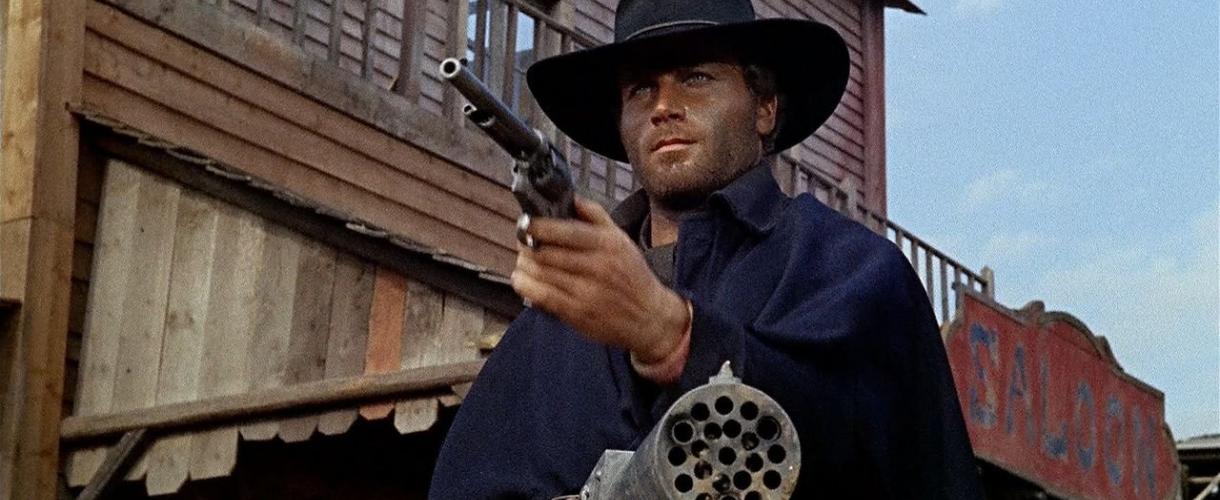
In Paris again the next summer I got a job as an office boy at Les Films Marbeuf. This didn't provide much valuable work experience, but I didn't care. Marbeuf distributed the most legendary of these B westerns, Sergio Corbucci's "Django." It is to this great, mad, violent spaghetti western—and its many sequels—that Quentin Tarantino's forthcoming film, "Django Unchained," alludes. In the Corbucci film Django (played by a young Franco Nero) arrives in a muddy shantytown on foot, dragging a coffin. In the coffin is a machine gun with which he will shortly kill many enemies. Why does he do this? Apparently they are racist Southerners who wear red hoods rather than white ones. In a brief scene Django visits his wife's grave and reflects that she was murdered by the leader of the bad guys, Major Jackson. Why the major killed her, and why Django has waited so many years to take revenge, is entirely unclear. And, equally, unimportant.
My enthusiasm for "Django" and its contemporaries rivaled that of a young Elizabethan treated to the London theater of the Rose or the Globe. Who cared why the Dane waited so long to murder his uncle? There was mayhem! There was murder! There was madness! There was music! And a ghost! The enthusiasm for these things shown by the best Renaissance playwrights—Marlowe, Webster, Kyd, Middleton—rivaled the spaghetti western auteurs' equal passion for arbitrary killing, crucifixions, loud music and scenes with white-clad villains abused by talking parrots.
On those Paris trips I saw many Italian westerns, and very few other films. Among the most vividly memorable are:
Spaghetti westerns were most exhilarating when they were at their most political. Sergio Sollima's "Big Gundown" starts as a cat-and-mouse police chase but ends with the heroes (a Mexican bandit and American sheriff) uniting to kill their employers in the final showdown. His "Face to Face" shows how a liberal university professor (Gian Maria Volonté, great actor and mainstay of so many of these films) can become a fascist monster given the right circumstances.
These were all formidable films. Visually extremely striking, aurally distinctive, wonderfully acted, violent, mystifying, perversely inspirational. Watching these films—so individual, so strange, frequently so bad—encouraged me to think I might make films just like them, in the cowboy hovels of the same surreal Spanish desert. When it came about in 1986, my own spaghetti western, "Straight to Hell" (a digital redux released last year as "Straight to Hell Returns"), was nowhere near as good as even the worst of these films. But it was shot in the same desert where they made "For a Few Dollars More" and "The Good, the Bad & the Ugly," just across the street from the Leone ranch. And it was the most fun, and the best experience, for me, of all the films I've made.
How I miss that desert! No matter the heavy black wool costumes and 110-degree weather and collapsing wooden boardwalks and adobes dissolving back into the sand. Luckily for me and others of like madness, Film Forum has reassembled the Parisian dream list outlined earlier, as well as several other great examples of the form. Thrillingly, most of the projections won't be digital: 35-millimeter prints will be in attendance, the way these films were intended to be shown.
 |
 |
 |