     |

























"You can't be an authentic punk and be in the establishment."
—Writer/Director Alex Cox
|

Cox was born in Bebington, Cheshire, England in 1954. He attended Worcester College, Oxford, and later transferred to the University of Bristol where he majored in film and TV, graduating in 1977. Seeing difficulties in the British film scene at the time, Cox secured a Fulbright Scholarship, allowing him to study at the University of California, Los Angeles in the United States, where he graduated from the School of Theater, Film and Television with an MFA. There he produced his first film, Edge City (also known as Sleep Is for Sissies), a 40-minute surreal short about an artist struggling against society.

|
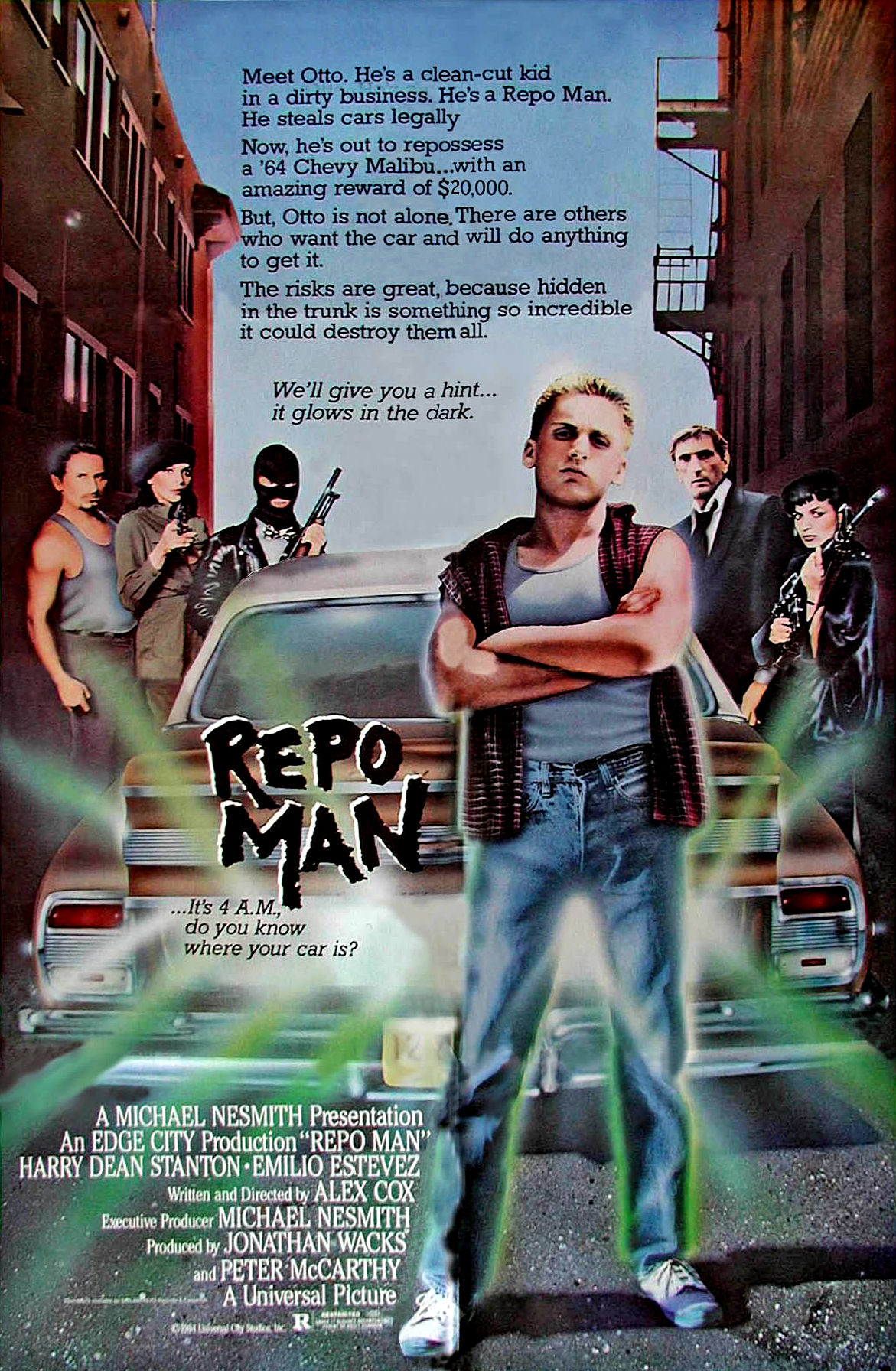
Michael Nesmith agreed to produce Repo Man, and convinced Universal Studios to back the project with a budget of over a million dollars. Cox's directorial debut, Repo Man stars Harry Dean Stanton and Emilio Estevez, with Tracey Walter, Olivia Barash, Sy Richardson, Vonetta McGee, Fox Harris, and Dick Rude among the supporting cast. Set in Los Angeles, the plot concerns a young punk rocker (Estevez) who is recruited by a car repossession agency and gets caught up in the pursuit of a mysterious Chevrolet Malibu that might be connected to extraterrestrials.
During the course of the film's production, the studio's management changed, and the new management had far less faith in the project. The initial cinema release was limited to Chicago, followed by Los Angeles, and was short-lived... But after the success of the soundtrack album (notable for featuring many popular LA punk bands), there was enough interest in the film to earn a re-release in a single cinema in New York City. It ran for 18 months, and eventually earned $4,000,000. Repo Man received widespread acclaim, and was deemed by critics to be one of the best films of 1984.

|

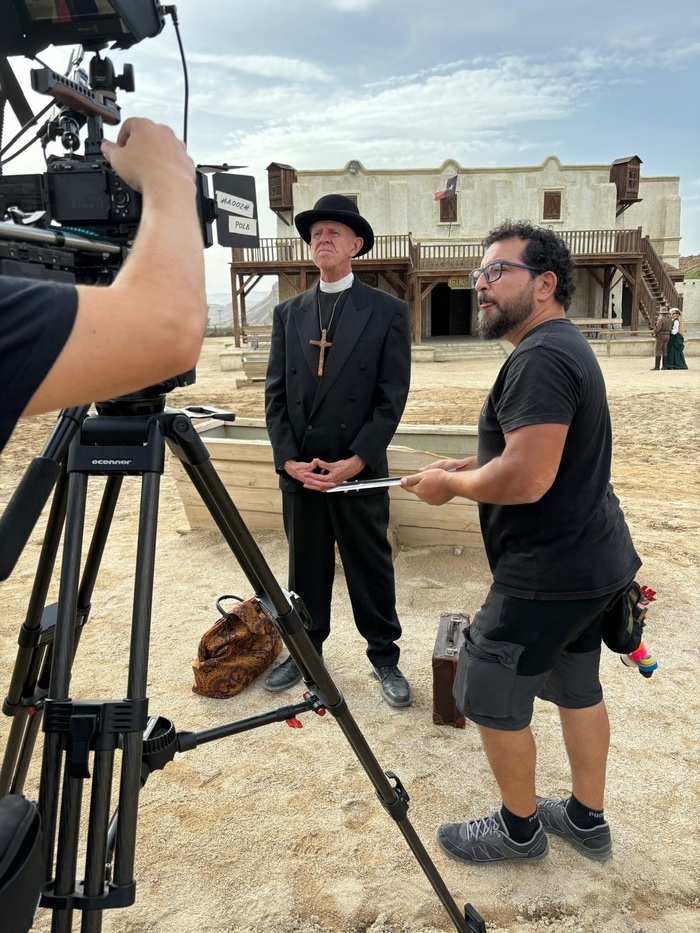
Cox had long been interested in Nicaragua and the Sandinistas (both Repo Man and Edge City made references to Nicaragua and/or Latin American revolution), and visited in 1984. The following year, he hoped to shoot a concert film there featuring the Clash, the Pogues and Elvis Costello. When he could not get backing, he decided instead to write a film that they would all act in. "The producer was sure that somebody would pony up $20,000 for all of these musicians to go to Nicaragua and perform a rock and roll concert. I was gonna have a guy dressed up as one of the actors from the film and go with the rock and roll show and dressed as William Walker and have it be like William Walker's Rock and Roll Show with Joe Strummer, and the Pogues and Elvis Costello. But we couldn't raise the money and so that's why Straight to Hell happened." Cox threw together a script over several days, collaborating with Dick Rude (who also co-starred beside Strummer, Sy Richardson and Courtney Love), creating a spoof of the Spaghetti Western genre, filmed in Almería, Spain, where many classic Italian westerns were shot. "All the musicians who had given us a month free; they'd arranged to be available the month of August 1986 to be on the rock and roll tour of Nicraragua. And when that didn't happen the producer suggested let's do a feature film instead. We wrote the script very quickly and made that film."
|

|

In May 1988 Cox began to adapt a story by Argentine poet and writer Jorge Luis Borges for the BBC. Given his choice of stories, he picked the 1942 short story Death and the Compass (Spanish title: La muerte y la brújula). It stars Peter Boyle, Miguel Sandoval, and Christopher Eccleston. Mexican actress Zaide Silvia Gutiérrez makes her second appearance in a Cox film here, her first being in El Patrullero. Despite being a British production and an English language film, he convinced his producers to let him shoot in Mexico City. This film, like his previous Mexican production, made extensive use of long-takes. The completed 55-minute film aired on the BBC in 1992. Cox had hoped to expand this into a feature-length film, but the BBC was uninterested. Japanese investors gave him $100,000 to expand the film in 1993, but the production ran over-budget, allowing no funds for post-production. To secure funds, Cox directed a "work for hire" project called The Winner (director's cut here). The film was edited extensively without Cox's knowledge, and he tried to have his name removed from the credits as a result but was denied, but the money was enough for Cox to fund the completion of Death and the Compass. The finished, 82-minute feature received a limited cinema release in the US, where the TV version had not aired, in 1996. Soon after, Cox was set to direct Fear and Loathing in Las Vegas for Rhino Films, but was replaced by Terry Gilliam due to creative differences with Hunter S. Thompson.² Cox was never employed again by a major Hollywood studio.
In 2006, Alex Cox tried to get funding for a series of eight very low budget features set in Liverpool and produced by locals. The project was not completed, but the director grew interested in pursuing the idea of a film made for less than £100,000. He had originally hoped to shoot Repo Man on a comparable budget, and hoped that the lower overhead would mean greater creative freedom.
 |
|

Cox had attempted to get a Repo Man sequel, titled Otto's Hawaiian Holiday, produced in the mid-'90s, but the project fell apart, with the script adapted into a graphic novel of the same name (with Otto's name changed to Waldo, for legal reasons). For his next micro-feature, he wrote a fresh attempt at a Repo follow-up, although it contained no recurring characters, so as to preserve Universal's rights to the original. Repo Chick was filmed entirely against a green screen, with backgrounds of digital composites, live action shots, and miniatures matted in afterwards, to produce an artificial look. It premiered at the Venice Film Festival on 9 September 2009.
Cox then began teaching film production and screenwriting at the University of Colorado at Boulder. During his tenure there, Cox supervised students who wrote, filmed and starred in the feature Bill, the Galactic Hero, developed from a science fiction book by Harry Harrison. The idea for this project was for film students to make an actual film with supervision from professional film makers, giving their time on the film for free. The film was funded by a successful Kickstarter campaign, raising $114,957 of the original $100,000 goal.
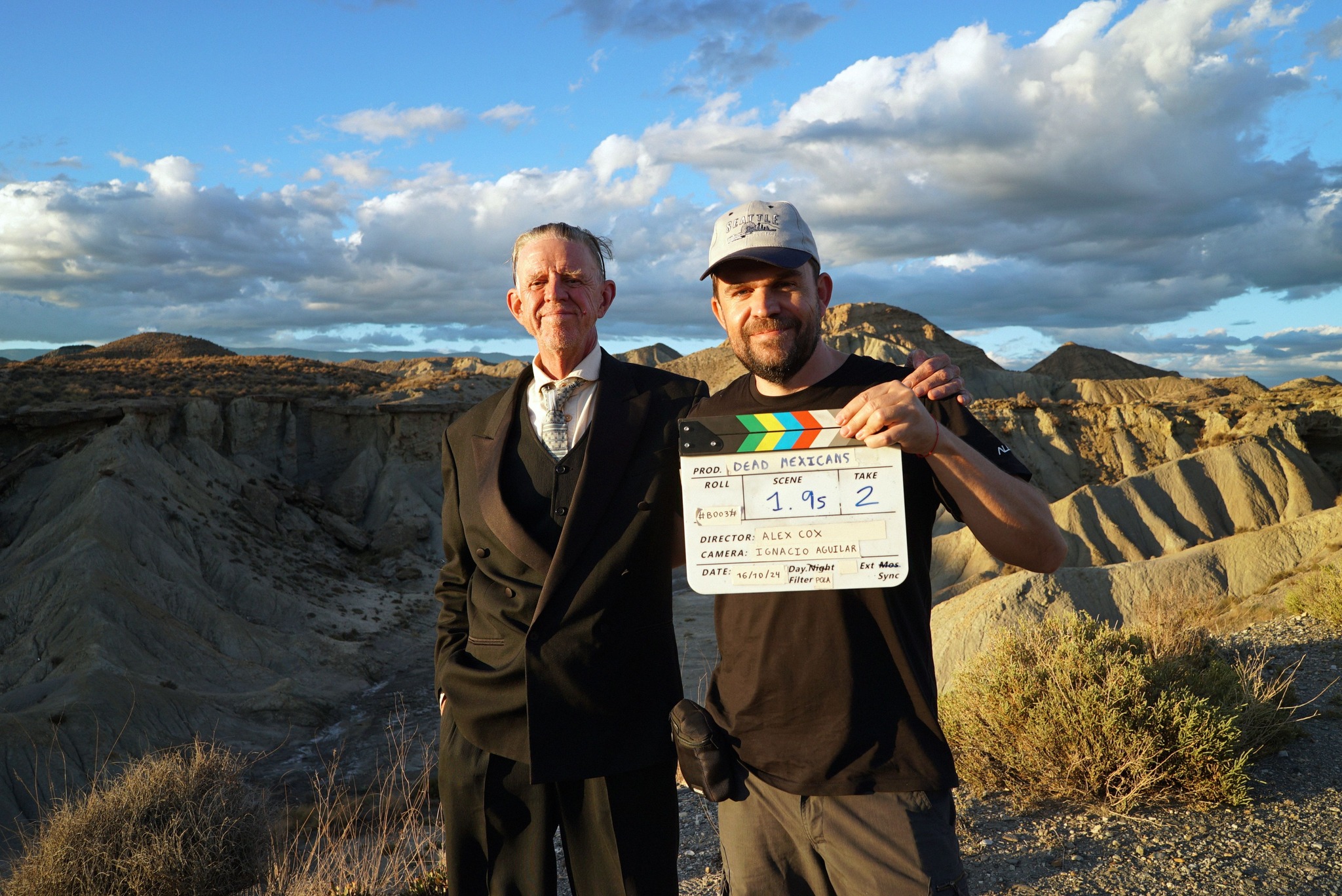
In 2017 Cox released another crowdfunded film, Tombstone Rashomon, which tells the tale of the gunfight at the O.K. Corral from multiple perspectives in the style of Akira Kurosawa's 1950 film Rashomon. The experience of filming in that area of Arizona connected Cox to many of the actors and crew that he is still using today in this project, an adaptation of Nikolai Gogol's novel Dead Souls, which Cox says will be his LAST FILM! Instead, let's hope it's just the latest chapter in this amazing, diverse, iconoclastic career. Cox resides in Colestin, Oregon, with his wife, writer Todelina Babish Davies.

NOTES ON THIS PAGE:
¹—Cox has worked in film for his entire adult life. Cox has cited Luis Buñuel and Akira Kurosawa as influences, as well as the Western film directors Sergio Leone, Sergio Corbucci, Sam Peckinpah, John Ford and Giulio Questi. But he's done other stuff, too! Cox was the host of Moviedrome on the BBC. He's also an author, who wrote a book on the history of the "spaghetti western" genre called 10,000 Ways to Die, as well as books on The Prisoner, the Kennedy assassination, and other topics. Cox is a fan of the Japanese Godzilla films and appeared in a 1998 BBC documentary highlighting the series. He also narrated the documentary Bringing Godzilla Down to Size and wrote the Godzilla in Time comics for Dark Horse. He tried to direct an American Godzilla film at one point, but unsuccessfully submitted his outline to TriStar Pictures. Cox is an atheist and is decidedly left-wing in his political views. Many of his films have an explicit anti-capitalist theme or message. (Socialist Godzilla? Could have been interesting!) Cox has written numerous educational books on film and television and co-hosted the podcast 'Conversations with Cox and Kjølseth' with his friend and colleague Pablo Kjølseth.
²—In this writer's opinion, Cox had drafted a better screenplay with Tod Davies, but Thompson didn't like it for obvious reasons: While both Cox's and Gilliam's scripts are based on the same book, in the Gilliam version, writer Raoul Duke and his attorney, Doctor Gonzo, descend on Las Vegas and meet various hippies, groupies, fascist cops and media people who represent the sad end of the 1960s dream. In Cox's (frankly superior) screenplay, Duke and Gonzo, both aging burn-outs and addicts who have no interest in their jobs or the outside world, hole up in their hotel room and represent the end of the 1960s dream themselves. Since the fictional character of Duke represented the very real Thompson, it's pretty easy to see why he didn't fancy the script.
SOURCES:
"The filmmaker too tough to die: Director Alex Cox returns to Boulder with his latest film Tombstone-Rashomon," by Michael J. Casey, Boulder Weekly, February 23, 2017. "During Cox's tenure at CU, he crowdfunded a feature film adaptation of Harry Harrison's Bill, the Galactic Hero and used his students to bring it to the screen. Bill was funded by a successful Kickstarter campaign, one that gave Cox hope that there might be a new way to make movies. But as Cox quickly learned, the science fiction of Bill proved an easier sell than the Western style of Tombstone-Rashomon. "When I saw how little money we raised, [I thought] 'We are so screwed, man!' Cox says with a hearty laugh. "We were so screwed because we had no money at all." Cox and company adjusted their already micro budget to $50,000 but still only managed to raise $31,642 with 297 backers on Indiegogo. Not nearly enough to tell their Tombstone story with the ambition Cox had in mind. Thankfully, friends in high places came to the rescue. "We were really lucky because a video streaming company, Fandor, came in and added to the budget," Cox explains. "Then the producers of Snowden and the Iggy Pop documentary, Gimme Danger, also came in and matched what we raised from Indiegogo and Fandor. So, it was still minimal but at least we could afford to feed people and have horses." And with a crew of roughly 60 people, Cox set off to Old Tucson Studios to shoot his version of the Gunfight at the O.K. Corral, only his version would be a spin on the nature of narrative and drew inspiration from Akira Kurosawa's 1950 seminal film about conflicting firsthand accounts, Rashômon."
"Alex Cox en MiniHollywood Regreso al Desierto (Canal Sur TV): Alex Cox vuelve tras 38 años al Desierto de Tabernas, después de rodar allí Straight to Hell, esta vez para realizar un largometraje western, con la que afirma que será su última película, pero de una forma distinta. Su nueva propuesta cinematográfica parte de la novela Almas Muertas, de Nicolai Gogol, para hacer una 'versión Western' de una historia irónica y misteriosa que se desarrolla en 1890 en Arizona y se llamará Dead Mexicans. Para retratar esta estampa, Cox pretende grabar en dos localizaciones: Tucson (Arizona) y, por supuesto, la provincia de Almería, dónde @minihollywoodoasys será uno de los sets principales del rodaje en nuestra provincia. Y para saber más de la película y conocer mejor a este icónico y ecléctico director, MiniHollywood Oasys ha realizado una mesa redonda, moderada por @carlosjvives ( @laoficinalmeria ) y compuesta por @josetabernas (alcalde de Tabernas); la cineasta, @margarets_dream Schindler y los periodistas, @carlos.juan.16 y @manuelcg1 ( @csuralmeria ); Pepe Cuenca ( @dipalmeradio ); @evaristomr ( @lavozdealmeria ) y @diegodimec ( @diariodealmeria ). La producción de esta mesa, estuvo realizada por @leonardogimenezmartin (Armería & Atrezzo Leonardo); @andy_arche (A&A Fotografía) ; @davidmirallesquesada & @el_indaliano ( @un_nuevo_renacer_producciones ) @diego_perez_cano ( @proyecto_cine_tv ); Pablo Torres (@detorresfw ) y @csuralmeria." (2nd Report) (3rd Report)
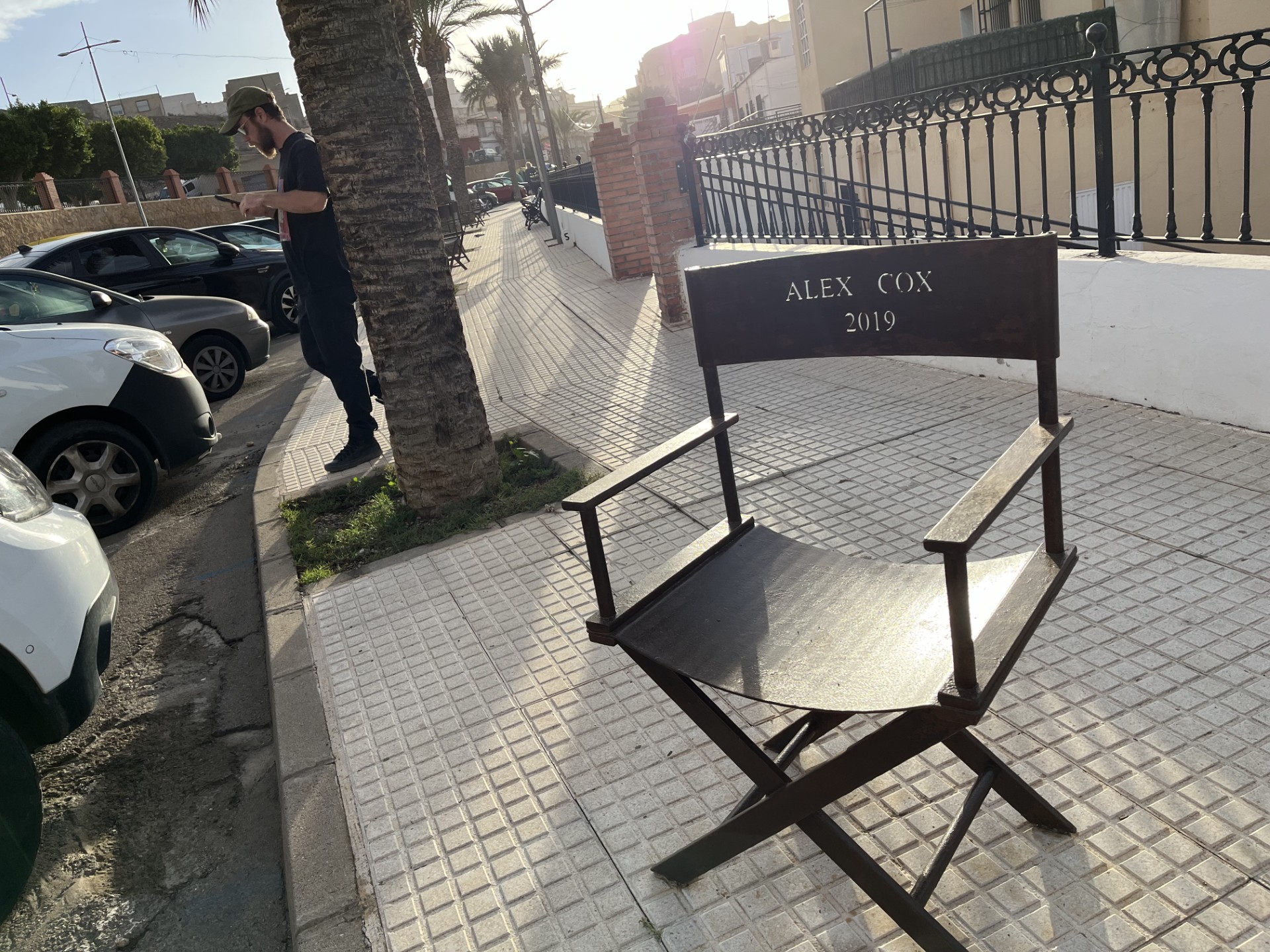
A bronze director's chair dedicated to Alex Cox in Tabernas, Spain, the city's equivalent to a Walk of Fame star in Hollywood. These chairs honor those who have contributed to Spain's cinema history.