     |
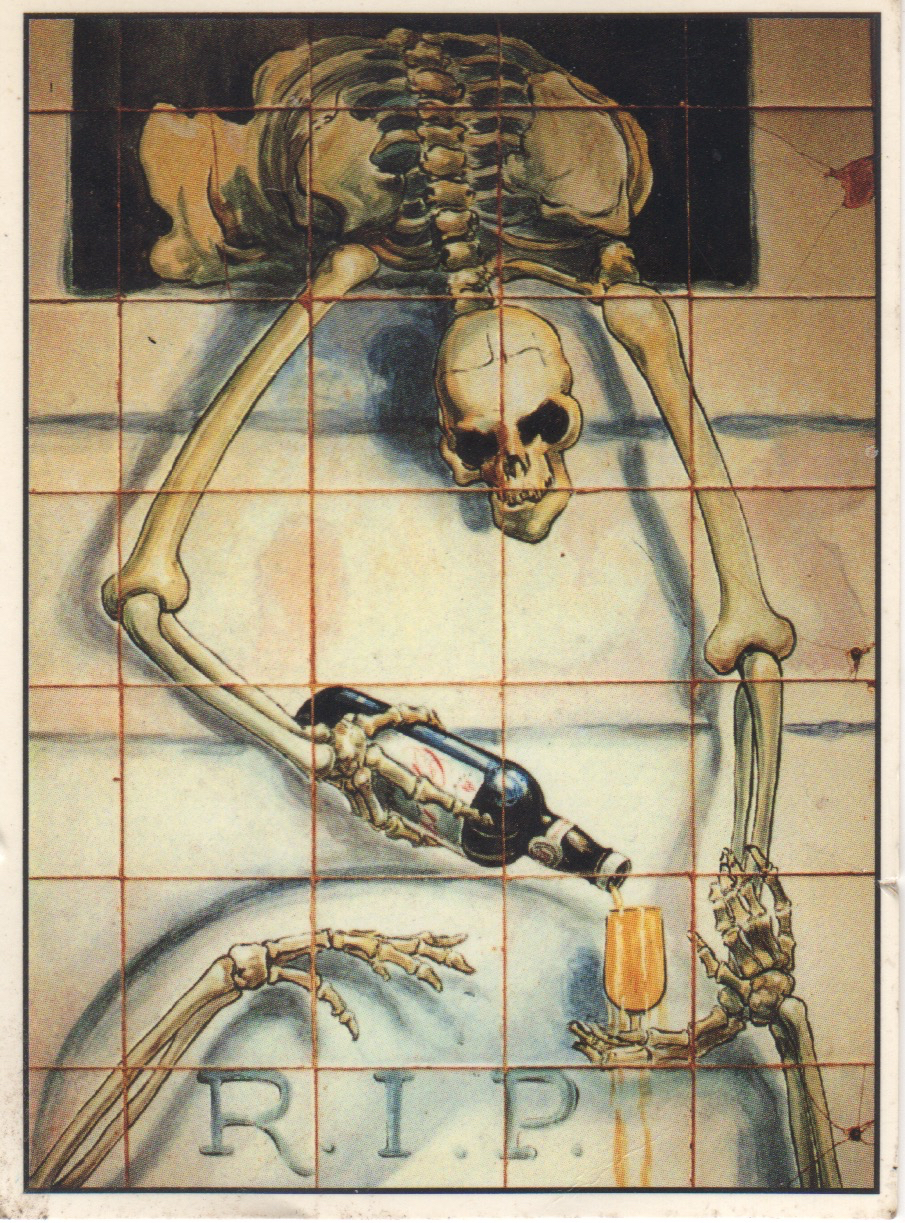





















"I didn't say we had no fire. God spared us that misfortune. Gonzales burned himself up on his own. Too much to drink. A blue flame came up out of him, and he turned to charcoal. Best farrier I ever had."
—The Widow
|

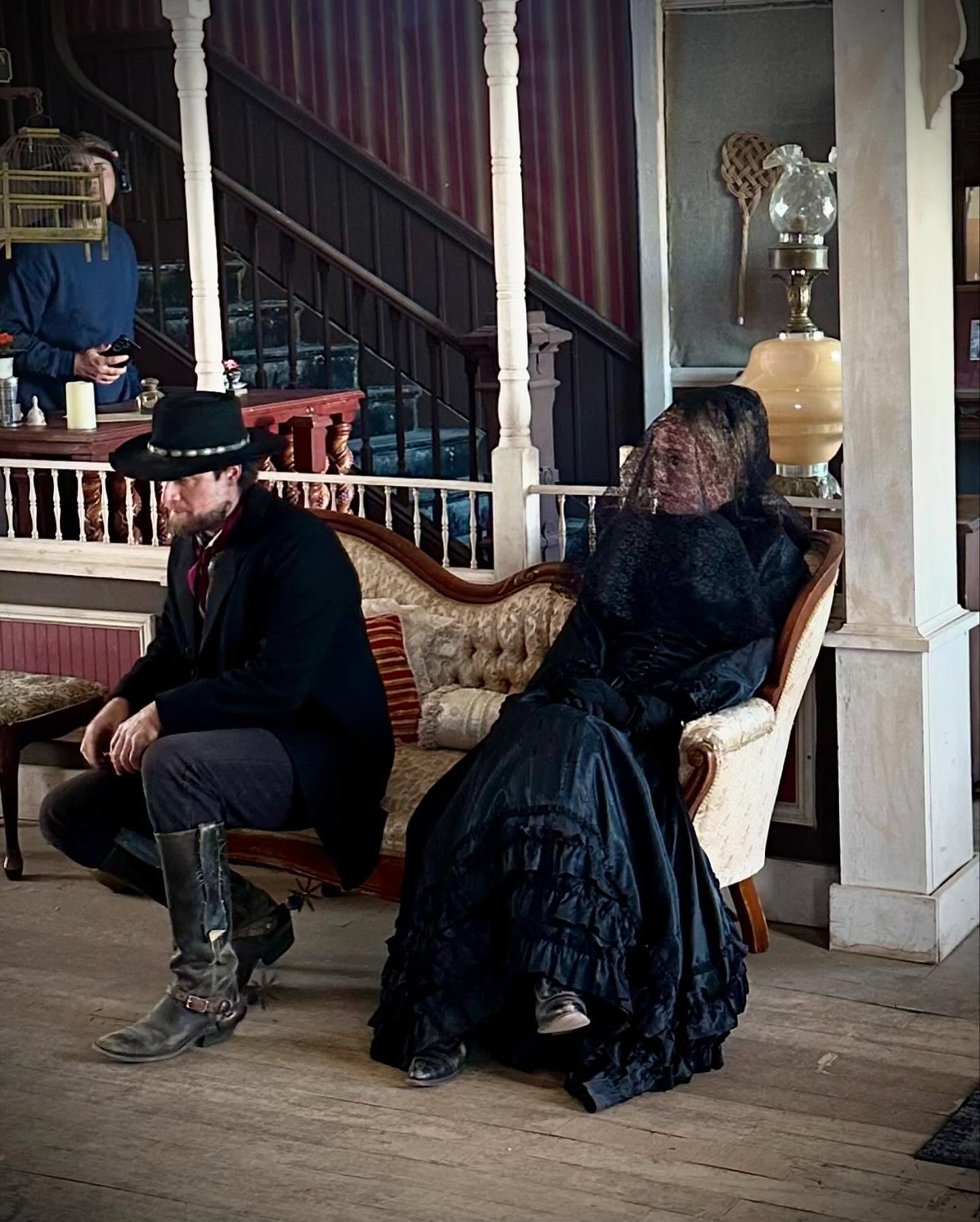
Sarah has joined the unoffical-but-highly-respected Alex Cox acting company. Cox announced, "She will play the Widow. Sarah is a chanteuse, popularly known as The Girl With Gunsight Eyes. She is an expert in Western ballads—classical, such as Streets of Laredo, and cinematic, including Django and Johnny Guitar. I met her at the Almería Western Film Festival three years ago." (She also must have met Gianni Garko there, as they are pictured together, below) Sarah went right into her research, and shared a snippet from a popular women's fashion magazine from 1857 called Godey's Lady's Book which describes the widow's veil as 'blinding and stifling' but intended to protect a woman in deepest grief against the 'untimely gaiety of a passing stranger.' Cox adds, "Apparently some of these veils contained poisonous dyes which sickened their wearers. So the Widow in (this film) has reason to be pissed off."
Sarah's official bio reads: "With a hand-picked posse of musical desperadoes alongside her, Sarah Vista creates a dark and dangerous country style that doffs the stetson to classic artists like Loretta Lynn, Nancy Sinatra, Nick Cave, Marty Robbins and Johnny Cash while also veering into spaghetti western territory. Her powerfully emotive vocals are the velvet glove but her truly original lyrics are the iron fist. Lee Powell from UK Rock & Roll magazine nailed it when he called Vista's music "a unique blend of Morricone-esque western soundtrack style sounds and brooding, blood-soaked balladry."

"Song choices include a parody of 'The Yellow Rose of Texas' and a 'Streets of Laredo' number led by bombshell Sarah Vista, who plays a widow convinced that Strindler has cheated her."
—Betsy Sherman | The Arts Fuse, Boston's Premier Online Magazine | July 28, 2026
|

"The live work continued, taking this unique sound out on the road and converting the unaware into true believers. The cynics and anyone who dared to doubt the Vista vision fell into the dust like corpses. Those that remained to sneer weakly could not survive the next blast as the debut long-player Killing Fever did its damage in 2018. A dozen self-penned tracks carefully sliced into two distinct portions. The 'country' side is authentic and with a wistful edge that soothes the soul and lulls you into a false sense of security before the 'western' side, dark as a blood-stained blanket, unleashes tales of revenge, retribution and menace that send icy shivers down the spine. The notches on her gun pile up like bodies in a range war.
"Front covers on the esteemed publications 'UK Rock & Roll' and 'Mad Music For Bad People'... Bang! All over 'Vintage Rock' magazine like a heat rash... Boom! Ameripolitan Award for Honky Tonk Female 2020... in the saddlebag already and only a dead man would have doubted it! Even Wolfgang Doebeling of Germany's 'Rolling Stone' magazine got the message and awarded Killing Fever top single of the year as he also gave the album a hard to achieve 4 stars in print. This set of releases on the Gallow Romantic label, in a dizzing array of formats, have also led to a host of international bookings in America, Spain, Sweden, Italy, Germany and beyond. For Sarah Vista... the trail never goes cold.

"Even the dark clouds of corona couldn't hold her back and Sings Songs From The Silver Screen emerged late in 2020 to ease the damp brow of any critters aching from Vista fever. Ten songs from a wide range of horse operas get Sarah's unique treatment. Sweet, haunting and menacing all at once. Her version of Wandrin' Star could bring Lee Marvin to his knees but A Woman Like Me sends an icy shiver down the spine. Only a fool would question Sarah's cinematic sincerity and her 'Sunday Saloon' videos show a genuine love for the western genre.Vengeance never sleeps and when this damned, dirty plague subsides Sarah Vista will be back on the road again. A second full-length album is also on the cards and a new selection of engaging songs with the sharp edge of a bowie knife are brewing quietly in a backwoods still. The fuse is lit on this new creation, the explosion is tantalisingly out of reach... for now. It's a fistful of audio dynamite heading your way. The girl with gunsight eyes can't be stopped. (Text by Craig Brackenridge, 2021)


|

Mourning was a social ritual. It was seen as a sign of respect, suffering a loss that should be honored and those feelings being matched by the sobriety of the garment being worn. Widows were expected to wear mourning clothes for a minimum of two years, but could wear them for up to four years: The first year, widows wore only black clothing with little to no embellishments. Custom forbade fabrics that reflected light during deep mourning, so lusterless black crepe veil was worn to conceal their face when they left the house. Crape was a matte silk gauze that had been crimped with heated rollers; dyed black; and stiffened with gum, starch, or glue. It is a heavy, scratchy fabric that does not breathe well, making it incredibly unpleasant to wear regularly—not to mention every moment of every single day for years. In addition, veils were typically a woman's full height and were secured by the hat. This made crape veils incredibly heavy, difficult to breathe through, and difficult to see through. By the 1880s, medical journals had begun a discussion about the health effects of heavy crape veils. The New York Medical Journal declared crape respiratory "the irritation to the respiratory tract caused by minute particles of poisonous crape," while a syndicated column from the North-Western Lancet declared the mourning veil "a veritable instrument of torture" in hot weather, staining the face and filling the lungs with toxic particles. In fact, many of the substances used to color and treat crape were seriously toxic, and as the 19th century progressed, the dyes in use only became more dangerous. In addition to wearing mourning clothes, widows were also expected to:
- Avoid social functions.
- Correspond on black-lined stationery.
- Wear jewelry made of dark black jet or the hair of the deceased.
The strict prescription and the style of dress also reinforced the widow's social ostracism, she could not go out into society for a year and it was considered poor form to accept invitations or appear in public, and calls were paid only by relations and very close friends. It was only in the second year could the widow resume any semblance of social life and even then, the widow could be seen both as an object of pity and a threat—the former because of the sense of loss and loneliness as a result and the latter because she was legally free to remarry or not as well as seen as much more sexually experienced. Hence the "woman in black" was seen both as a tragic figure... and a temptress.
 |
 |
 |
 |
NOTES ON THIS PAGE:
¹—"Louder Than War," by Andy Duke: "Vista's dark humour and dry wit infuses the genre with an infectious and irresistible blend of American and British."
²—"New York Medical Journal, Volume 50," by D. Appleton & Company, 1889 (p. 289-290)
³—"Update 3: Sarah Signs Up" by Alex Cox, 6/29/2024.